Andre de Ruyter’s strategy would have killed Eskom


Andre de Ruyter’s strategy at Eskom was focused on retiring coal-fired power stations and allowing the private sector to pick up responsibility for electricity generation in South Africa.
If this strategy continued for an extended period of time, Eskom would have been completely replaced and no longer exist.
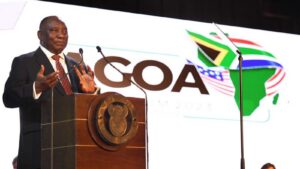
This is feedback from Eskom chairman Dr Mteto Nyati, who explained at a recent investment conference in Sandton that the utility’s board was deeply unsettled by De Ruyter’s strategy when it was appointed towards the end of the former CEO’s tenure.
Nyati said the new board felt uncomfortable with the strategy implemented before 2023 and concerned that it would not yield the results Eskom and South Africa needed.
This strategy was focused on retiring old power stations and allowing the private sector to pick up the responsibility for electricity generation in South Africa.
While the private sector is set to play an expanded role in electricity generation in the coming years, Eskom is not going anywhere, with the utility still investing in fresh generation capacity.
South Africa is on track to create a competitive electricity market, within which Eskom and private players will compete to supply customers.
The pre-2023 strategy, Nyati explained, would have ended up with this market only being served by private players and Eskom effectively disappearing.
“If you played this strategy forward for another 20 or so years, you would not have had an Eskom,” Nyati said.
Eskom’s board of directors could not let this happen, as their first responsibility is to ensure the business’ sustainability and ongoing operation.
As a result, it made a conscious decision to participate in the future of electricity in South Africa, which involves a competitive market with private players.
Eskom has created Eskom Green, which is investing heavily in building renewable capacity. Nyati said this would ensure that electricity generation is not something that is just left to the private sector.
Another strategy shift came in the form of Eskom’s Generation Recovery Plan, implemented by head of generation Bheki Nxumalo, which involved intense maintenance of the utility’s coal-fired power plants.
This has given them a new lease on life and has seen their reliability greatly improve, contributing meaningfully to the end of load-shedding.
Nyati made it clear that coal will play a part in South Africa’s future energy mix, with Eskom working hard to find a way to make it cleaner to generate electricity from the fossil fuel.
Andre de Ruyter under fire

De Ruyter has come under immense criticism in recent months, following his statements on the current situation at Eskom and how it has managed to end load-shedding.
He has also repeated his calls for some of the credit in improving operations at the utility, with his tenure getting the ball rolling regarding improvements at its generation facilities.
“I took on a pretty tough job, and I gave it my best effort. I really worked hard to try to make it a success. I think that I started to put some momentum back into the system,” De Ruyter said.
“A large organisation is like a flywheel. Once that flywheel has come to a complete standstill, it takes a huge amount of energy to get it moving again.”
De Ruyter believes he played a crucial role in getting the utility moving in the right direction again, with the fruits of his labour only being seen after his departure.
“Once it moves, you just need to give it a tap every now and then to keep the momentum going. But, to get it moving takes an enormous effort,” he said.
“Once that happens, then the process works again. I know I have this association with the Prince of Darkness, but I do think that I made that contribution to getting the momentum back.”
“This is particularly true with regard to the damage wrought by my less-than-illustrious predecessors.”
Despite his calls for some of the credit, De Ruyter’s successors have not given him any and have instead sharply criticised the former CEO.
At the investment conference, Nyati made a point he has made several times before, saying that when he became chairman, they found leaders were not leading at Eskom and managers were not managing.
Previously, Nyati said De Ruyter crushed Eskom staff morale and failed to get employees pulling in the same direction.
“When we landed in Eskom, there were hardly people within the head office. People were staying at home and exploiting the hybrid working model,” Nyati said.
“You cannot afford that. You need to have people around who work as part of various teams. But, they were hardly there.”
“They found that each time they were listening to their leader, the leader was saying all sorts of things about them being the source of the problem.”
“How can you be excited to come to work when you are being seen as the person who is creating the problem?”
Nyati previously explained his surprise at how little support De Ruyter had from within Eskom due to his management of the utility.
“He had a lot of support externally. What surprised me was that there was no support for De Ruyter in Eskom,” Nyati said. “That is dangerous. Who are you leading when you see nobody is following you? That is the problem.”



Comments