Good news about petrol prices in South Africa


South African motorists are set for major relief at the pumps next week, with data indicating that substantial cuts will be made to fuel prices across the board.
Both grades of petrol are expected to come down by over 50 cents per litre, with diesel prices expected to have a smaller cut at around 20 cents per litre.
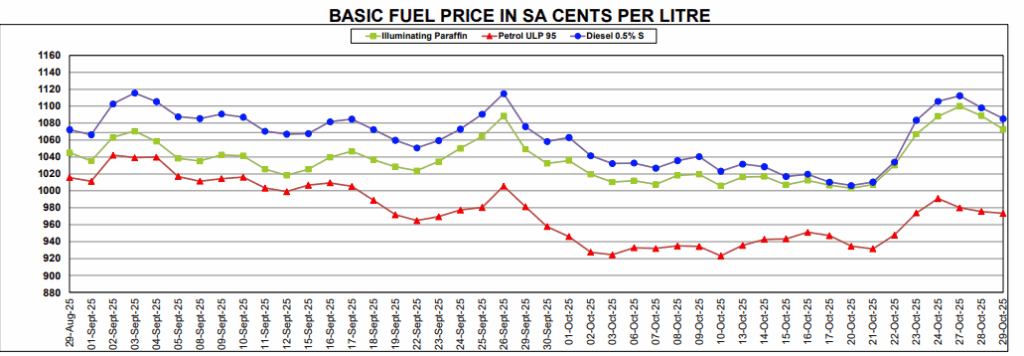
This has been driven by a decline in international oil prices and a slightly stronger rand against the dollar, despite widespread uncertainty regarding trade relations between the United States and China.
The Central Energy Fund tracks the fluctuations in the international price of oil and the rand-dollar exchange rate to forecast changes for fuel prices in South Africa.
Its latest data indicates the following changes for fuel prices when the official changes are announced next week –
- Petrol 93 – decrease of 56 cents per litre
- Petrol 95 – decrease of 51 cents per litre
- Diesel 0.05% – decrease of 22 cents per litre
- Diesel 0.005% – decrease of 20 cents per litre
These expected declines have largely been driven by a steady weakening of international oil prices over the past month.
This downward trend is despite intensified sanctions on Russia’s two largest oil companies and increased trade tensions between the United States and China.
A major driver of the decline in oil prices is the increased supply coming from members of the Organisation for Petroleum Exporting Countries (OPEC).
The organisation has lifted the production caps it placed on members to try to maintain a stable, elevated oil price.
This renewed supply has been coupled with fears of a slowdown in demand as global economic growth comes under pressure, resulting in a record forecasted oil surplus for the coming year.
As a result, Brent Crude international oil prices are on track for their third consecutive monthly decline, the longest losing run for the commodity in a year.
Furthermore, OPEC members are expected to increase production further in December, with a meeting scheduled for 2 November.
In addition, the rand has strengthened against the United States dollar over the past month as commodity prices remain elevated and easing global tensions boost emerging market currencies.
Investors are also increasingly concerned about the United States government’s financial health, with its debt crossing $38 trillion.
This has resulted in the US dollar and American assets not being seen as the traditional safe-haven assets they once were. Investors are looking elsewhere, most prominently towards gold, for safety.
The rand has been impacted by the renewed global instability over recent weeks, with the United States swinging between imposing increased tariffs on China and backpedalling.
This uncertainty appears to have dissipated, with US President Donald Trump meeting his Chinese counterpart Xi Jinping in South Korea this week.
Trump said he had an “amazing meeting” with Xi, with significant progress being made on various issues of contention between the countries.
The graph below, courtesy of the CEF, shows the general downward trend in the price of fuel over the past month, with a noticeable uptick in recent days due to increased global uncertainty.






Comments