The three provinces left in the dark in South Africa


Gauteng, Limpopo and Mpumalanga are the three provinces that have been hardest hit by Eskom’s implementation of load reduction.
The utility recently unveiled its plan to curb load reduction, with its sights set on ending it entirely by 2027.
However, this will require intensive, multi-pronged efforts, including the rollout of smart meters, registering residents for free basic electricity and
Eskom presented its plan to eliminate load reduction in a recent presentation to the Portfolio Committee on Electricity and Energy.
Eskom renewables manager Kubeshnie Bhugwandin explained that load reduction is not the same as load-shedding.
Instead, it is a proactive approach that Eskom uses to manage electricity consumption, particularly during periods of high demand, like in the morning and evenings.
Bhugwandin explained that load reduction is a “last resort measure” to protect network equipment like transformers and cables.
Eskom general manager Collin Reddy said the national electricity supply crisis is no longer the utility’s “dominant headache”, with its attention now shifted to eliminating load reduction.
“Load reduction is necessary when we have a specific feeder or transformer that becomes overloaded due to illegal bypasses, metering, tampering, theft or vandalism,” he explained.
“And it’s really an excessive load or demand that is put on the transformer that risks the transformer or other equipment failing.”
He said that, in some cases, this excessive demand risks permanent damage, as it creates a fire risk that could harm the equipment or any people nearby.
Therefore, load reduction is not a supply issue like load-shedding, but rather a network issue, where Eskom needs to implement load reduction to protect equipment like transformers.
Over the past year, Eskom has experienced 771 transformer failures and implemented load reductions on 971 feeders across the country. Reddy said this impacted 1.6 million of the utility’s customers.
He further explained that load reduction is more widespread across some provinces, primarily in Gauteng, Limpopo and Mpumalanga.
This is because load reduction is implemented across the country, but concentrated in overloaded feeders caused by high electricity theft.
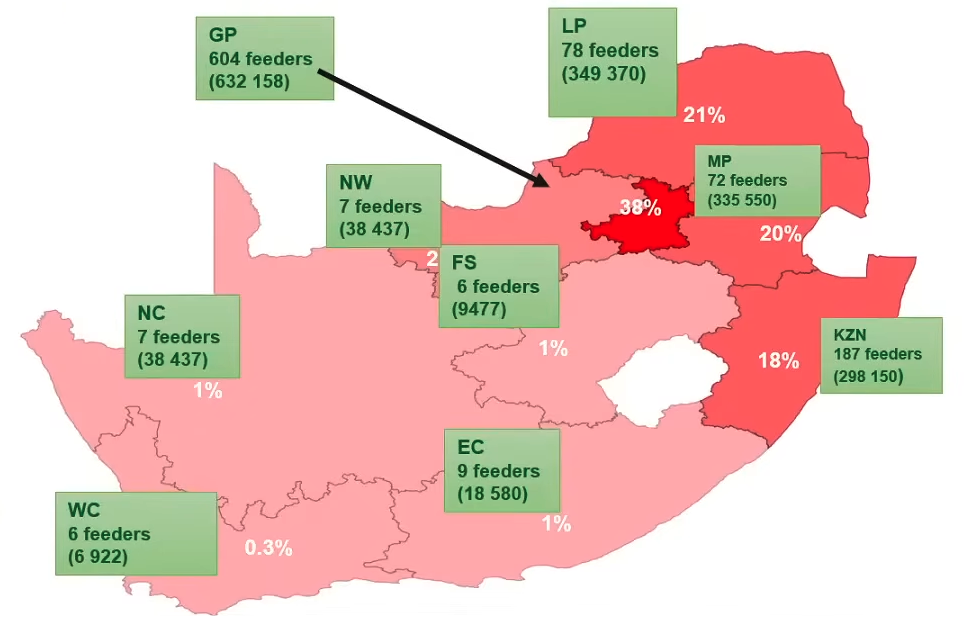
The percentage of customers impacted by load reduction in South Africa’s nine provinces can be seen in the graph below.
Gauteng takes the top spot at 38%, far higher than any other province in the country. It is followed by Limpopo at 21% and Mpumalanga at 20%.
KwaZulu-Natal is not far off from the top three at 18%, while the rest of South Africa’s provinces are all below 2%.
Eliminating load reduction
Reddy said Eskom is taking a multi-pronged approach to eliminating load reduction by 2027, starting with increasing the use of free basic electricity.
The government’s Free Basic Services policy was adopted in 2001 to provide free services to South Africa’s most indigent households.
Between 2001 and 2009, this policy expanded to include free basic electricity, water, solid waste removal, and sewerage and sanitation services.
Under this policy, the government provides free basic municipal services to eligible households at no charge.
However, the percentage of South Africans receiving free basic services has declined significantly over the past decade. This is largely due to municipalities having become more selective, and awareness of this option lacking.
According to Stats SA, the percentage of consumer units using the free basic electricity service dropped from 25% to 14% between 2014 and 2023.
Reddy explained that increasing the uptake of this service is expected to curb illegal connections, therefore lessening the load placed on network infrastructure.
He said Eskom has identified that 2.1 million customers that could qualify for this service, significantly more than the 485,000 that currently use it.
The second focus area for eliminating load reduction centres on smart meters, with Eskom set to take a phased approach in rolling out more of these devices to households across the country.
Reddy explained that this technology allows Eskom to see what is being consumed at different transformer zones and makes the low voltage network visible to the utility.
Smart meters also give Eskom a granular view of what is happening at a feeder level or a transformer zone level, allowing the utility to ioslate which areas are under excessive strain.
“The smart meters provide us with technical agility in terms of managing and monitoring the networks,” he said.
The rollout of this technology to more households will also help Eskom better identify and end illegal connections, which will further reduce the excessive load placed on network infrastructure that necessitates load reduction.
The phased rollout of these meters to more households in the country will take place over the next two years, with Eskom eyeing around 1.69 million smart meters to be rolled out by March 2027.
The third “prong” of Eskom’s multi-faceted approach is centred on Distributed Energy Resource deployment, focusing on hard-to-reach communities.
This strategy will see the utility prioritise areas providing essential services like schools and clinics in load reduction zones and feed excess renewable energy into local networks in these areas.





Comments