South Africa’s R17 per litre petrol price pain


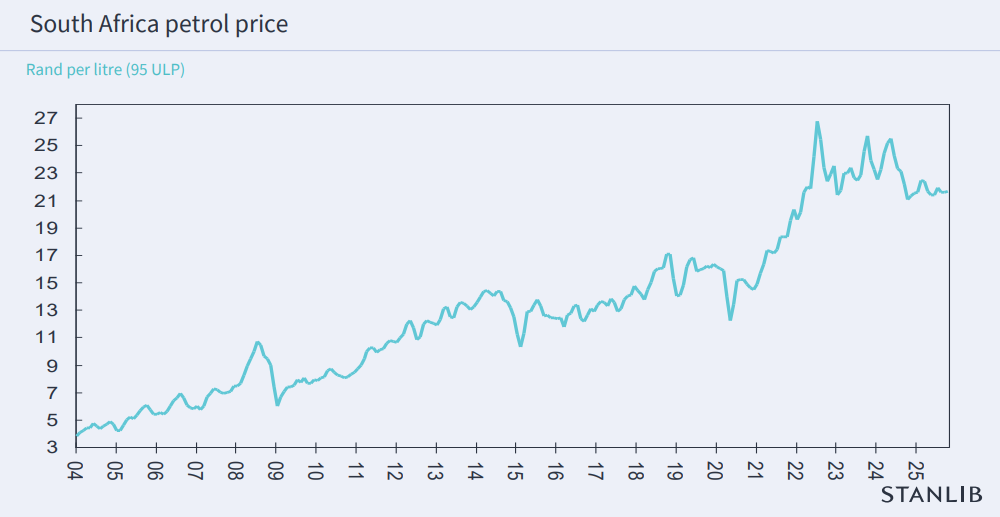
Petrol prices have risen from around R4 per litre in 2004 to over R21.48 per litre as of October 2025, despite oil prices declining over the past decade.
This means that the price of petrol in South Africa has risen by more than R17 in just over two decades, significantly increasing the cost of living and putting upward pressure on inflation.
It has also increased the cost of doing business as over 85% of South African goods travel via road for at least part of their journey.
The rise is largely explained by significant increases in the taxes levied on fuel in South Africa and the steady weakening of the rand.
While the price of oil has risen over a 20-year horizon, it is flat over the past decade, when the most steep increases in the petrol price have occurred.
The price of petrol in South Africa is made up of two main elements, the Basic Fuel Price and administered elements.
The Basic Fuel Price is determined by the international price of oil and the rand-dollar exchange rate. This price is essentially the cost of importing the fuel into South Africa.
Thus, a stronger rand makes importing fuel cheaper, while a weaker currency increases the price of bringing fuel into the country.
Administered elements, on the other hand, include the taxes levied on fuel and various other components, including retail margins, transport costs, and wholesale margins.
These elements are a significant reason why the price of fuel has risen so strongly over the past decade, with the state increasingly looking to fuel levies to raise its revenue.
The General Fuel Levy, at R4.01 per litre, is by far the largest of these levies, followed by the Road Accident Fund (RAF) Levy. Together, these two levies make up 29.6% of the price of petrol at the pump.
For each litre of petrol, South Africans are paying R6.37 in taxes. For each litre of diesel, they are paying R6.24 in taxes.
In total, these taxes have risen by R4.13 for each litre of 93-octane petrol to R6.23 in 2025 – an increase of 50.85% in a decade.
While these taxes were initially levied for specific purposes, to maintain and upgrade roads and fund the RAF, they have increasingly been seen as a means to increase government revenue.
Fuel levies are one of the easiest methods of raising revenue, as it is relatively simply administered and levied on a large base of taxpayers.
In effect, the increase is spread across millions of South Africans and not highly concentrated like personal income tax or corporate income tax.
The graph below, courtesy of Stanlib chief economist Kevin Lings, shows the increase in the price of petrol over the past two decades.
A weak rand
Apart from significant increases in the taxes levied on fuel in South Africa, the cost of petrol has also risen due to a substantially weaker rand over the past 20 years.
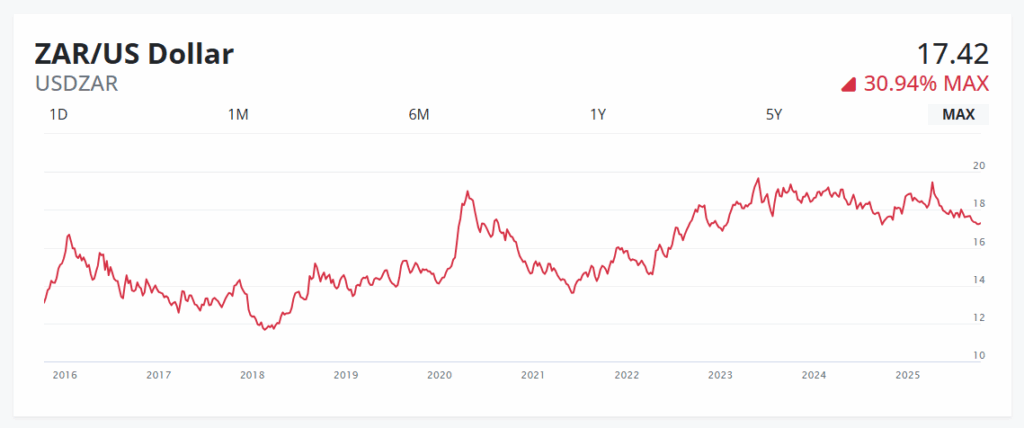
The rand weakens at an average rate of 5% a year against the US dollar, making it progressively more expensive to import fuel.
While the currency’s short-term movements capture attention and coverage, its longer-term weakening is far more predictable.
A currency’s movements in the short term typically reflect prevailing sentiment towards a country, with longer-term trends based on economic growth and the state’s financial health.
The country’s trade balance also plays a significant role in the value of a currency, with South Africa typically enjoying a positive balance in recent years.
However, on the other counts of economic growth and government finances, South Africa is in a far worse place now than it was 20 years ago.
The country’s economy has been stagnant for over a decade, with its average annual growth rate since 2010 being only 1.1%.
This has resulted in foreign investors dumping local assets, as they look for better returns elsewhere, weakening the rand.
It has also played a direct role in the state’s current financial difficulties, with lacklustre economic activity resulting in weak tax collection.
This is despite a strong increase in government spending, with its increased expenditure having little effect on economic growth.
As a result, the state’s debt burden has gone from 24% as a share of GDP to over 77%, indicating that the country is edging closer to a debt trap.
This has been a major factor in pushing international ratings agencies to downgrade South Africa’s investment rating to junk status, further crushing investor sentiment.
These longer-term factors behind the rand’s weakening have been coupled with short-term hits for currency from rising global uncertainty to domestic political instability.
Over the past decade, the local currency has weakend by over 30% against the US dollar, significantly increasing the cost of importing fuel.




Comments