Best news for petrol prices in South Africa in four years


The oil price in rands has hit a four-year low due to a weakening of the dollar amid the US government shutdown and weaker international oil prices as supply rises and demand slows.
This should translate into lower petrol prices for South African motorists in November, but a lot can still change by then.
However, the price of oil in rands is not the only determinant of the price of fuel in South Africa, with taxes making up an increasing share of the final price at the pump.
The Basic Fuel Price, made up of the international oil price and the rand-dollar exchange rate, is the main swing factor as it fluctuates regularly, whereas taxes levied on fuel tend to only change once a year during the National Budget.
Thus, the international oil price and the rand-dollar exchange rate are the key factors in determining petrol prices in the immediate term.
The rand’s strength is particularly crucial as it determines the price South Africa pays to import oil and other petroleum products into the country.
As South Africa produces very little of its own oil, the strength of its currency is vital in determining the final fuel price.
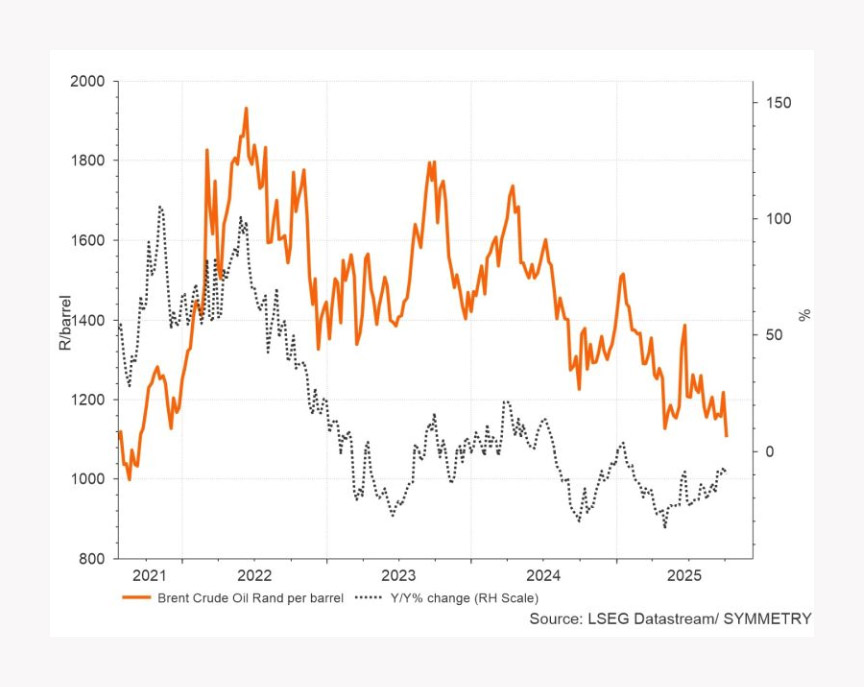
Chief investment strategist at Old Mutual’s Symmetry Izak Odendaal explained that the rand oil price has declined steadily throughout 2024 and 2025.
This has been good for local inflation, helping limit price increases and enabling the Reserve Bank to cut interest rates.
Odendaal said the rand oil price hit a four-year low at the end of last week, with the rand strengthening to R17.24 to the US dollar and Brent crude oil prices dipping to $64 a barrel.
The rand has strengthened somewhat since then, dropping below R17.20 at times so far this week, while the oil price has remained relatively stable.
Odendaal explained that the year-on-year change in the rand oil price has been creeping up recently due a base effect that will roll off again. In effect, the rand oil price is declining at a slower rate.
This remains good news for the South African inflation and interest rate outlook, with low fuel prices likely to result in easing price pressure and potentially rate cuts if other factors play their part.
A lower rand oil price is likely to translate into decreases in the price of petrol and diesel next month, with the Central Energy Fund’s latest data indicating substantial cuts.
The data shows the following cuts are expected for November, if the rand’s current strength holds and the oil price remains stable –
- Petrol 93 – decrease of 47 cents per litre
- Petrol 95 – decrease of 45 cents per litre
- Diesel 0.05% – decrease of 11 cents per litre
- Diesel 0.005% – decrease of 10 cents per litre
The graph below, courtesy of Odendaal and Symmetry, shows the decline in the rand oil price over the past few years.
Relief limited by taxes
The decline in the rand oil price to its lowest level in four years does not mean that petrol prices will return to the levels seen towards the end of 2021.
This is because of the repeated increase in taxes levied on fuel in South Africa and the expansion of various other administered elements of the price.
The administered component of the fuel price, including taxes and margins, has grown strongly in the past decade.
These elements have accounted for a greater share of the final fuel price than the price of oil and the exchange rate since 2015.
The most substantial levies placed on the sale of fuel include the General Fuel Levy (GFL) and the Road Accident Fund (RAF) Levy. Other elements include the wholesale margin, retail margin, and transport and storage costs.
All of these elements have increased above the rate of inflation in South Africa over the past decade, apart from the wholesale margin.
For example, the RAF levy has risen by 44% in real terms over the past decade, with the retail margin and transport cost rising by 40% and 49%, respectively.
The GFL, more commonly known as the fuel tax, has risen by a similar amount over the past decade.
As a result, these administered elements of the fuel price now account for around 60% of the final petrol price at the pump.
In the third Budget Speech presented this year, Finance Minister Enoch Godongwana raised the GFL for the first time in four years.
The increase pushes the GFL to R4.01 per litre of petrol at the pump and R3.85 per litre for diesel.
Combined with the RAF Levy, taxes alone make up 29.6% of the price of petrol and 32.2% of the price of diesel at the pump. South Africans pay R6.37 in taxes for each litre of 93-octane petrol and R6.24 per litre of diesel at the pumps.
In total, these taxes have risen by R4.13 for each litre of 93-octane petrol to R6.23 in 2025 – an increase of 50.85% in a decade.
Road Freight Association CEO Gavin Kelly said the increases in taxes levied on fuel is largely due to the government’s excessive spending, with these taxes being a soft target for the state to collect more revenue.
“It goes to the basis of how the South African government finds revenue to fund the costs of government and financing its services,” Kelly said.
Increasingly, the government has to consider how it is going to pay off and finance its growing debt burden, with debt-servicing costs being the fastest-growing item in the Budget.
“Using the fuel levy is one of the easiest methods of raising revenue. It is a large base of taxpayers across which the increase can be spread,” Kelly said.
While personal income tax and corporate income tax are highly concentrated, anyone who purchases fuel in South Africa pays the GFL.
“If you increase the levy by a few cents, you then spread the so-called base on which you tax across millions of South Africans,” Kelly said.
“However, the problem is that this has become a very easy lever for the government just to find funds that they cannot find anywhere else.”
“The real issue here is that the government needs to cut its spending, not just find easier avenues to generate revenue.”
 Loading ...





Comments