Big petrol price cuts on the cards for South Africa


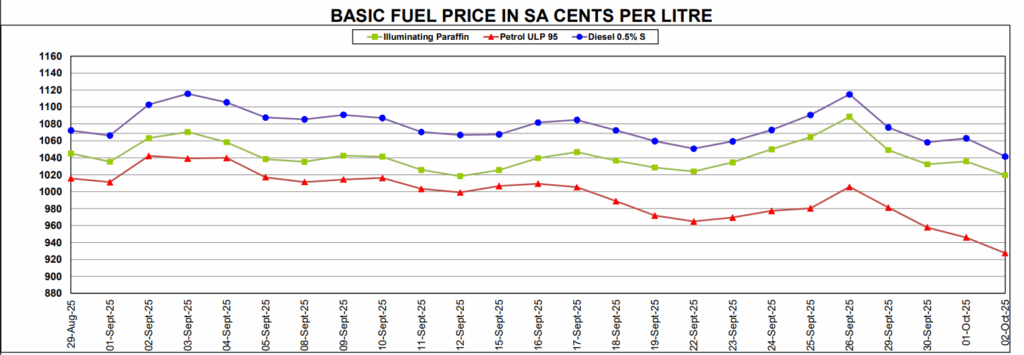
South African motorists are set for significant relief in November, with early data indicating a substantial decline in petrol prices.
This will be coupled with a relatively smaller cut to diesel prices, which have come down in the past few months on the back of easing supply from refineries in North America and Europe.
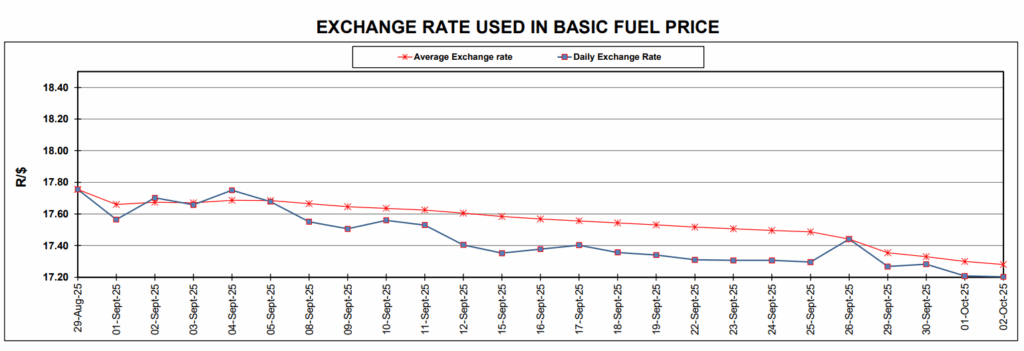
Petrol prices are set to come down largely as a result of a strengthening rand, with oil prices only down marginally in the past month.
Oil prices continue to face some upward pressure from renewed strikes on Russian refineries by Ukraine and increasing pressure from US President Trump on participants in the Middle East conflict to agree to his peace proposals.
The latest data from the Central Energy Fund (CEF), which tracks fluctuations in the rand’s value and oil prices to forecast changes to petrol and diesel prices, indicates the below changes for November –
- Petrol 93 – decrease of 42 cents per litre
- Petrol 95 – decrease of 38 cents per litre
- Diesel 0.05% – decrease of 6 cents per litre
- Diesel 0.005% – decrease of 4 cents per litre
These changes are likely to be significantly different by the time the Department of Mineral and Petroleum Resources announces the official alterations to fuel prices for November at the end of the month.
However, the prospects are looking good for relief, with the rand continuing to gain against the dollar as the United States government appears to be in an extended shutdown until Congress can agree on a deal to raise the debt ceiling.
The rand has also gained on the back of greater expectations for rate cuts in the US, which may result in capital flowing out of American fixed-income assets to those in other countries, including South Africa.
South Africa continues to have one of the most attractive yields on its government debt at over 9%, with rate cuts in the US only making this yield relatively more attractive to investors.
Old Mutual chief economist Johann Els has explained that the dynamic of the US Fed cutting rates faster than the South African Reserve Bank could result in the rand gaining a lot of ground on the dollar.
The rand remains far above its fair value, indicating that any positive tailwind could see it strengthen markedly against the dollar.
Els expects the rand to continue strengthening in the short term, with it trading far above its fair value of R11.54 to the US dollar.
On the other side of the equation, the price of oil has declined substantially in the past month on the back of renewed efforts for a peace deal in the Middle East.
However, if these peace efforts fail, Trump’s threats could result in a wider conflict in the region, threatening supply and pushing up the price of oil.
The price of oil remains under pressure for other reasons too, with the Organisation for Petroleum Exporting Countries (OPEC) continuing to increase supply as it steadily removes production caps.
Despite the price of oil not being elevated, these countries fear losing market share to US and Northern European producers.
OPEC increased output by 400,000 barrels a day in September, formally completing the restart of 2.2 million barrels a day of production halted in 2023.
Currently, the International Energy Agency projects the oil market will experience a record surplus next year, putting immense downward pressure on the price.
The combination of a weakening dollar and declining oil prices is set to result in substantial relief for South African motorists.
The graphs below, courtesy of the CEF, show the relative strength of the rand and the downward trend in fuel prices over the past month.






Comments