Former Eskom CEO slams Andre de Ruyter’s ‘fairytales’


Andre de Ruyter replaced engineering fundamentals at Eskom with “sponsored fairytales” about renewable energy and its ability to replace coal-fired power plants.
These fairytales resulted in South Africa experiencing the worst load-shedding on record during De Ruyter’s tenure, as the performance of Eskom’s coal fleet collapsed.
Now that engineering fundamentals have returned to the utility, load-shedding has seemingly come to an end and Eskom is producing billions of rands in profit.
This is according to former Eskom CEO Jacob Maroga, who oversaw the first stint of load-shedding in South Africa during his time at the helm of the utility.
Maroga’s comments come after Eskom released its latest set of financial results, revealing a R16 billion profit and a mere 13 days of load-shedding during the 2025 financial year.
The sharp critique of De Ruyter also follow his praise of the private sector in helping to bring load-shedding to an end through its investment in renewable energy.
Maroga took exception to De Ruyter’s comments, calling them “engineering gibberish” and said it was disingenuous to compare solar generation with coal-fired power plants.
“The real reason we had the worst era of load-shedding from 2021 to 2023 is that engineering fundamentals were replaced by sponsored fairytales. The lights are on because engineering competence returned to Eskom,” Maroga said.
For example, Maroga pointed to De Ruyter’s claim that weather-dependent generation can replace dispatchable coal capacity.
Eskom has attributed the significant reduction in load-shedding to its Generation Recovery Plan, which has been implemented since March 2023.
This plan emphasised intense maintenance at the utility’s coal-fired power stations, leveraging diesel open-cycle gas turbines (OCGTs) and private generation to give it the space to repair and replace equipment.
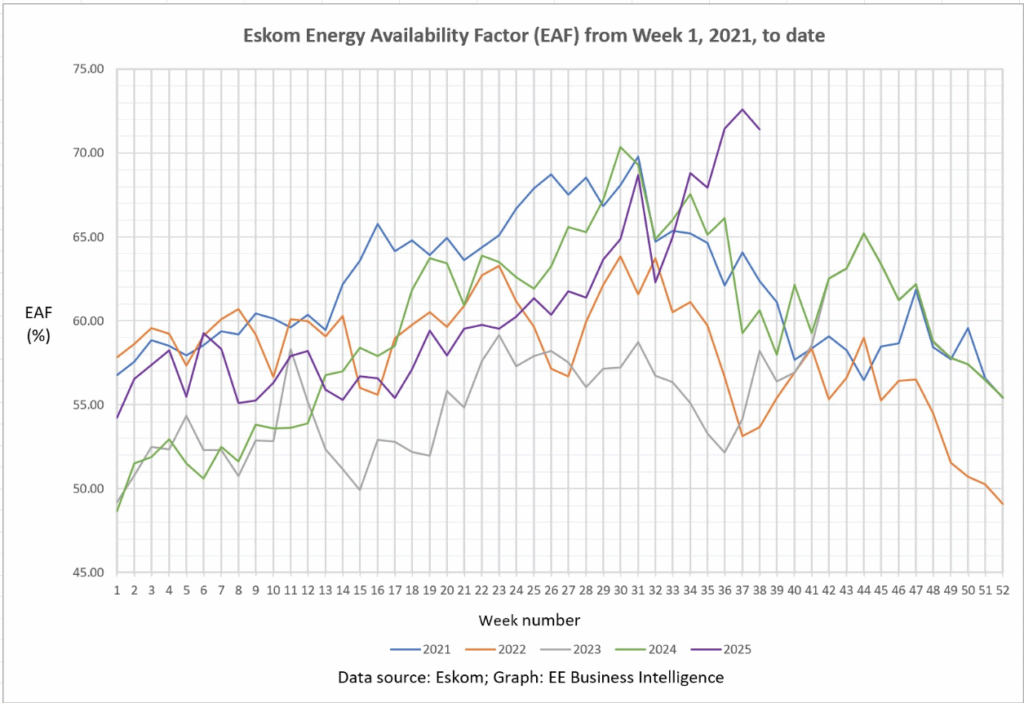
The plan has borne fruit, with the utility flagging a sharp decline in unplanned outages and a steady rise in its energy availability factor (EAF) from a low of 48% in 2023 to over 70% as of the end of September.
Eskom’s improved EAF can be seen in the graph below, courtesy of EE Business Intelligence managing director Chris Yelland.
Engineering gibberish
Maroga has previously referred to De Ruyter’s praise of renewable energy and its ability to replace coal-fired power plants as “engineering gibberish”.
De Ruyter said the end of load-shedding was a simple mathematical equation, with the addition of new generating units at Eskom’s power plants and renewable energy generation solving the issue of a lack of electricity.
This included the return of Koeberg’s two units after their steam generators were replaced, the connection to the grid of three Kusile units and the return of Medupi Unit 4.
The performance of Eskom’s other plants has also drastically improved after enhanced maintenance and management.
However, De Ruyter brought special attention to the role of the private sector, which he believes is overlooked in bringing load-shedding to an end.
“What is often omitted is the fact that the private sector, in a period of 18 months, added 6.1 gigawatts. That’s about the size of one-and-a-half Medupis, which took 15 years to build,” he said.
This is what Maroga took exception to, saying that one cannot compare baseload from coal power plants to solar generation.
“When he compared 6,000 MW of solar to 6,000 MW of coal power and its impact on the grid, that is where I disagree,” Maroga told BizNews.
“Solar power, which is intermittent and weather-dependent, is not equivalent in terms of its reliability to 6,000 MW of dispatchable, base load power.”
“In South Africa, when we have had a lot of load-shedding, there were suggestions that by simply adding solar power to the grid, we would reduce load-shedding.”
“My understanding and my engineering background say that the only thing that has reduced load-shedding is the improvement in the performance of the coal power stations.”
Maroga pointed to the drastic improvement in Eskom’s EAF from below 50% at the height of load-shedding to around 70% in September 2025.
“That improvement in the performance of the coal power stations is the thing that is a significant contributor to the reduction in load-shedding,” he said.
 Loading ...




Comments