Eskom searching for R112 billion


Eskom chairman Mteto Nyati said that, with energy security conquered, the utility will now turn its attention to energy affordability, with cost cutting set to play a key role.
Nyati explained that Eskom has turned its focus to driving down the cost of electricity in South Africa, which will not only make it more affordable to produce but also ensure the utility can keep future tariff increases inflation-linked.
The Eskom chairman explained this shift in focus in the latest instalment of PSG’s Think Big Series on Tuesday, 30 September.
The utility has already made significant efforts in regards to lowering its costs, with its 2025 results showing primary energy costs down 14% to R150.2 billion.
Nyati explained that Eskom’s new core programme, the Cost Optimisation and Revenue Enhancement Initiative, will be key in driving these costs down even further.
“That is the agenda that is going to be helping us to get energy to be affordable in this country,” he said.
“Renewables, together with the productivity drive within Eskom – those two things will help us to drive down the cost of electricity in our country.”
Specifically, this initiative will aim to result in R112 billion in cost savings for Eskom over a five-year period.
Nyati added that South Africa has seen the “peak” in Eskom’s electricity tariff increases, adding that, going forward, the country should not see tariff increases above CPI inflation.
“They need to be single digits, very much in line with everything else in society,” he said. “We are done with energy security. The next drive is energy affordability. That is what we are focusing on.”
This will be a big change for Eskom, which has become notorious for implementing far above inflation tariff increases over the past decade.
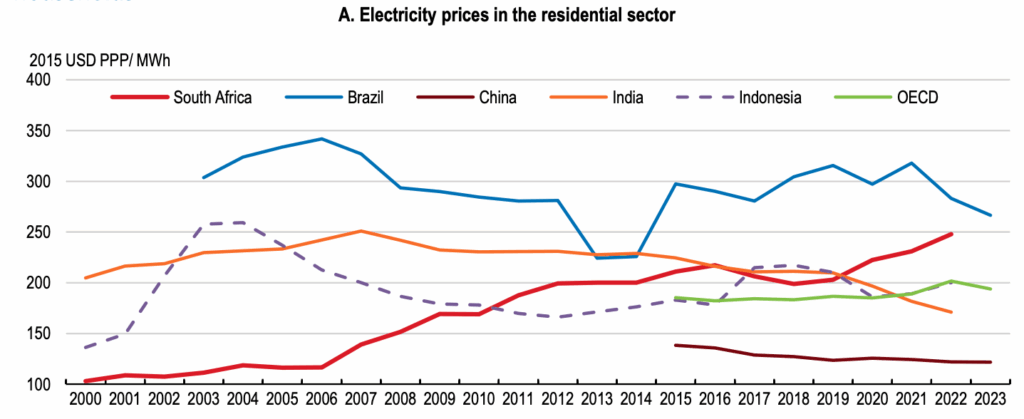
South Africa’s electricity prices have risen by 190% in the past decade, significantly outpacing inflation and placing immense financial pressure on households and companies.
For the 2025 year, Eskom proposed increasing electricity prices by 36.15%. However, the National Energy Regulator of South Africa (NERSA) rejected this proposal and approved a lower increase of 12.74%.
The graph below shows how South Africa’s electricity prices have grown relative to its emerging market peers.
Why South Africa’s electricity prices are so high
The Organisation for Economic Co-operation and Development (OECD) explained in its economic survey of South Africa, released earlier this year, why the country sees such high electricity prices.
The OECD said a major point of contention is whether to raise tariffs to reflect true electricity costs, after years of below-cost pricing that weakened Eskom’s finances and led to repeated government bailouts.
“Moving to a pricing methodology allowing cost recovery, however, must be balanced with affordability,” the organisation explained.
“Moreover, for a cost recovery approach to be acceptable, it is essential that services are delivered efficiently, minimising unnecessary costs.”
The OECD explained that the unreliability of electricity services combined with corruption and mismanagement have contributed to driving up operational costs and further complicates public acceptance of higher rates.
“Implementing cost-recovery tariffs is essential for Eskom’s financial health but requires progressing further towards efficient operations to avoid burdening consumers with unnecessary costs,” it said, adding that achieving this heavily depends on fundamental structural reforms.
It explained that a new framework introduced by NERSA, which is not in effect yet, could be the key to attaining this balance.
NERSA developed a new framework, the Electricity Price Determination Rules (EPDR), in December 2023. While it was initially set to take effect in 2025/26, its implementation is now on hold.
“While not a complete solution, the EPDR introduces improvements, including benchmarking costs across the sector, increasing transparency by unbundling generation, transmission, and distribution costs and removing the clawback clause that had allowed Eskom to raise tariffs to recover past losses,” the OECD explained.
“Advancing all of these reforms is essential to reach fair, cost-based electricity tariffs while ensuring support for low-income households.”
Currently, South Africa’s tariffs are determined based on the Multi-Year Price Determination (MYPD) methodology, which sets the allowable revenue that Eskom can earn to cover costs given expected electricity sales.
Using this methodology, Eskom applies for a particular tariff from NERSA, which either approves it or suggests another.
However, increasing conflicts between Eskom and NERSA over the years have shown the flaws of this approach.
 Loading ...




Comments