Say goodbye to Eskom as you know it


Eskom is currently transforming itself from a 20th-century monopoly into a modern electricity utility through the legal separation of its operating divisions and the formation of a competitive energy market.
The utility’s legal separation and the launch of Eskom Green are set to result in “The Eskom of the Future”, CEO Dan Marokane said.
Speaking during Eskom’s financial results presentation for the 2025 financial year, Marokane praised the utility’s employees for a much-improved performance.
Eskom posted its first annual profit since 2017, reduced its debt burden by R46 billion and made significant strides in bringing load-shedding to a permanent end.
However, the utility still has a substantial amount of work to do in creating a ‘modern’ Eskom and ensuring energy security for South Africa over the long run.
This includes finalising the legal separation of its Distribution and Generation divisions, while launching Eskom Green.
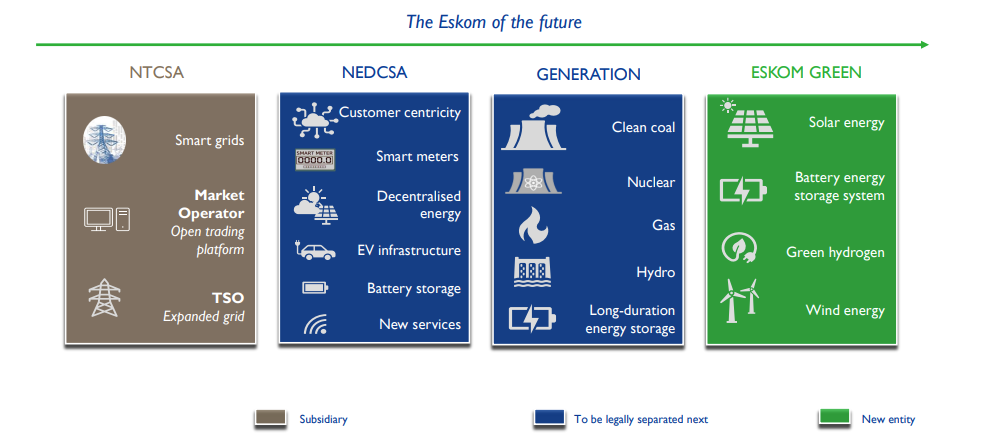
So far, the utility has only managed the full legal separation of its Transmission Division, with the new National Transmission Company of South Africa (NTCSA) operating independently of Eskom.
While these divisions will operate independently of Eskom, they will remain under the broad umbrella of the utility’s holdings company.
The separation of the Transmission division is set to be the most significant, with it being crucial to the creation of a competitive electricity market.
In effect, the NTCSA will operate an open trading platform on which electricity generators, including Eskom, will compete to supply users.
This will break Eskom’s stranglehold on South Africa’s electricity sector and open its Generation division up to private competition for the first time.
In theory, this should translate into Eskom’s operational performance improving as competition from private players forces it to be more price-competitive, efficient, and reliable.
While the seperation of the Transmission division is potentially the most consequential development, Marokane said the utility’s focus is now moving towards its other operating units and ensuring it can compete with private players.
The separation of the Distribution division is gathering increasing importance as it is the main culprit behind the increase in load reduction.
South Africa’s mismanaged electricity distribution infrastructure, managed both by municipalities and Eskom, is increasingly failing under increased load.
Electricity Minister Kgosientsho Ramokgopa has declared this as the next front in the war against electricity insecurity, urging the utility to help municipalities manage this infrastructure.
The formation of the National Electricity Distribution Company of South Africa is set to facilitate this in the future.
Crucially, the separation of these divisions is set to enable them to invest heavily in Transmission and Distribution infrastructure as they will have their own balance sheets, separate from the Eskom holding company.
The Eskom of the future, as outlined by Marokane, can be seen in the graphic below, representing the progress made in creating the ‘new’ utility.
Clouds gather over Eskom 2.0
Eskom’s integrated annual report provided more details about the creation of a future-fit utility and some of the major threats to its formation.
The Eskom of the future is “a resilient and future-ready utility that delivers energy security in the evolving electricity industry”, the utility said.
This will demand customer-focused products and services to meet changing needs, enhanced grid capacity and access, and clean energy business models.
All of this will require immense investment from the utility and the separated operating divisions, with Eskom looking to begin raising fresh debt from 2028 onward to fund the upgrading of infrastructure.
CFO Calib Cassim indicated at the financial results presentation that the utility plans to invest over R320 billion across the next five years in its infrastructure.
This includes the NTSCA, which will invest around R133 billion in transmission infrastructure to enable new generation capacity to connect to the grid.
The biggest threat to the Eskom of the future is the rise in municipal debt owed to the utility, which has crossed R100 billion.
“The biggest obstacle to any positive spiral is the municipal arrear debt challenge, which continues to compromise operational plans,” Eskom said.
Apart from compromising its existing operations, the rise in municipal debt threatens the legal separation of the Distribution division and funding for the Eskom of the future.
Cassim said the growth in municipal debt could render the R254 billion bailout the utility received from taxpayers useless.
Cassim explained in presenting Eskom’s financial overview that municipal debt owed to Eskom has grown by 9% in the past four months alone.
“If the growth of municipal debt is not addressed, the R254 billion debt relief from the government will effectively be null and void,” Cassim said.
“This does not help Eskom’s financial sustainability going forward. After this debt relief plan, we do not want to rely on the fiscus anymore.”
Worryingly, this indicates that the growth in debt owed to the utility is accelerating, despite efforts from the National Treasury, Eskom and the Electricity Ministry to address this issue.
Cassim said that without urgent intervention, municipal debt could exceed R300 billion by the end of the 2030 financial year – almost equivalent to the utility’s current debt burden.





Comments