Eskom proves Andre de Ruyter wrong


Eskom has significantly reduced its reliance on its diesel-powered generators over the past year, which has also seen the utility’s diesel spending go down substantially.
This is despite claims from former Eskom CEO Andre de Ruyter, who alleged that the utility is burning diesel at a rate of knots to keep load-shedding at bay.
Eskom’s results for the 2025 financial year, which ended on 31 March 2025, showed that this is not the case, as the utility has managed to reduce load-shedding without excessively using diesel.
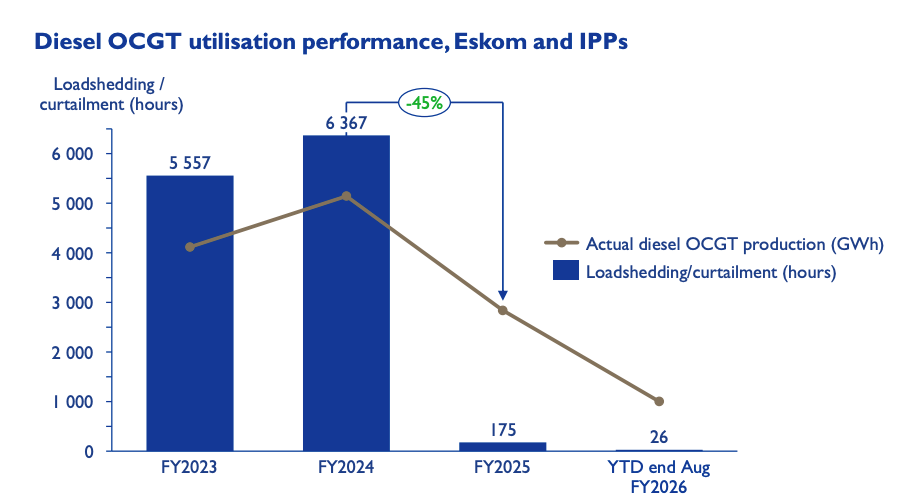
In 2025, Eskom managed to keep load-shedding limited to 175 hours, a significant improvement from the 6,367 hours seen in 2024.
At the same time, Eskom has reduced the use of its open-cycle gas turbines (OCGT), decreasing diesel OCGT production by 45% compared to 2024.
These OCGTs are power stations that use diesel as their primary fuel. They are meant to be used as temporary “emergency” generators when the supply from Eskom’s coal-fired power stations cannot meet demand.
Since diesel is a limited fuel source and very expensive, Eskom tracks its OCGT usage very closely.
To show the stark difference in price, Eskom’s generation cost for coal was R546/MWh in 2025, and R6,084/MWh for its OCGTs, which is an 8% decrease compared to 2024.
Eskom explained that it saw a marked improvement in primary energy costs in its 2025 financial year due to the higher availability of its coal-fired plants, which translated into lower OCGT usage.
This meant Eskom spent significantly less on diesel in the 2025 financial year, with the utility recording year-on-year diesel savings of R16.3 billion.
This trend is set to continue in Eskom’s 2026 financial year, as the utility’s OCGT production continued to decline between March and August 2025.
In a recent press statement, Eskom said that, from 1 April to 25 September 2025, its diesel expenditure has consistently remained well below the allocated budget, reflecting reduced reliance on the diesel fleet and a much greater reliance on the rest of the generation fleet.
The graph below shows how Eskom’s diesel spending has declined since its 2023 financial year.
Burning diesel
Former Eskom CEO Andre de Ruyter previously claimed that Eskom’s ability to spend significantly more on diesel is a large part of the reason why the utility has been able to keep load-shedding at bay.
Under De Ruyter’s tenure, South Africa experienced record levels of load-shedding. De Ruyter left the utility at the start of 2023.
At the PSG Financial Services’ Annual Conference in May 2024, he was asked how Eskom had been able to reduce load-shedding significantly after his departure.
De Ruyter explained that, during his tenure, Eskom only had a diesel budget of around R6 billion a year. “We were very aware of how we had to scrimp and save to use diesel very frugally and carefully,” he said.
However, he said the current administration has a diesel budget of around R24 billion – four times what De Ruyter’s team had.
“So, if the lights are on, well done, but they are on because we are pouring money into diesel at the rate of knots,” the former CEO said.
The former CEO repeated these comments in 2025, saying at the second annual BizNews Investment Conference that spending billions on diesel can make problems “magically” disappear.
While other factors contributed, De Ruyter noted that Eskom has been allowed to spend much more on diesel in recent years than it has in the past.
This enabled the utility to run its open-cycle gas turbine (OCGT) power stations much more frequently, despite their cost, to supplement Eskom’s coal-fired plants.
“When I was at Eskom, we were allowed to burn about R5 billion of diesel a year, which is a lot, and I felt bad for it because it’s very, very expensive electricity that we generate,” De Ruyter said.
“The latest budget is sitting in the region of about R23 billion to R24 billion. That’s not affordable. It costs about R6/kWh to generate electricity from diesel. So, if you’ve got unlimited money to throw at diesel, then problems magically go away.”






Comments