Eskom heading for R300 billion disaster


Municipal debt owed to Eskom is set to exceed R300 billion by the end of the 2030 financial year if urgent interventions are not successful.
The National Treasury’s initiatives have been unsuccessful in addressing the growth in municipal debt, with it increasing at a faster rate year-on-year.
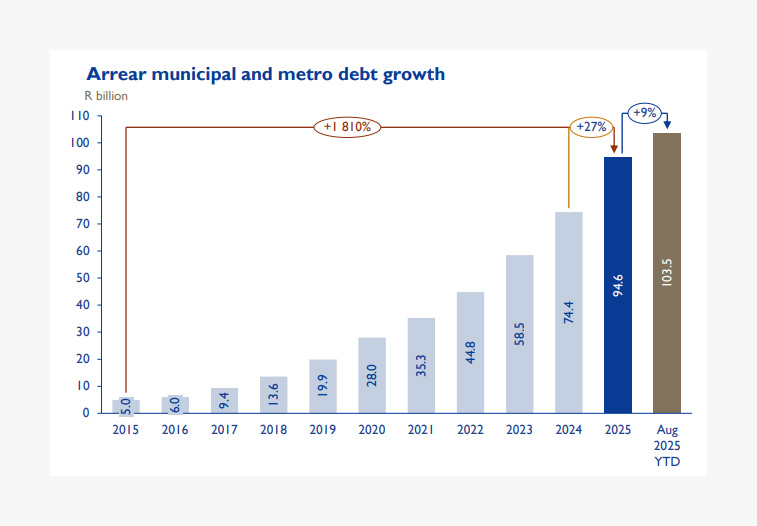
The debt municipalities owe the utility rose by 27% to R94.6 billion at the end of the 2025 financial year in March and amounted to R103.5 billion as of the end of August 2025.
This was revealed by Eskom at the presentation of its financial results for the 2025 financial year, where the utility posted a R16 billion profit.
Eskom’s greatly improved operational performance has translated into a much healthier financial standing.
Apart from posting its first profit in eight years, the utility also managed to reduce its debt burden from R412.2 billion to R372.7 billion.
However, Eskom’s financial stability is under renewed threat from the rapid growth in municipal debt owed to the utility.
Eskom CFO Calib Cassim said the growth in municipal debt could render the R254 billion bailout the utility received from taxpayers useless.
Cassim explained in presenting Eskom’s financial overview that municipal debt owed to Eskom has grown by 9% in the past four months alone.
“If the growth of municipal debt is not addressed, the R254 billion debt relief from the government will effectively be null and void,” Cassim said.
“This does not help Eskom’s financial sustainability going forward. After this debt relief plan, we do not want to rely on the fiscus anymore.”
Worryingly, this indicates that the growth in debt owed to the utility is accelerating, despite efforts from the National Treasury, Eskom and the Electricity Ministry to address this issue.
While the bulk of the debt was owed by a relatively small number of municipalities, larger entities and even metros are falling into the non-paying category.
The graph below shows the strong growth in municipal debt owed to Eskom since 2015.
Existential crisis
The rise in municipal debt owed to Eskom has become an existential crisis for the utility, with it threatening to undo the hard work done to improve the utility’s operational performance.
With the amount owed to Eskom crossing R100 billion in August 2025, the rate of growth has forced Eskom to change its financial outlook.
Cassim said that without urgent intervention, municipal debt could exceed R300 billion by the end of the 2030 financial year – almost equivalent to the utility’s current debt burden.
“Unless innovative solutions are found, the financial sustainability of Eskom as a whole, together with legal separation timelines of its operating units, are in jeopardy,” Cassim said.
Eskom and the government are exploring alternative solutions, including distribution agency agreements and prepaid supply models.
These new agreements are set to support municipalities in ensuring sustainable local service delivery while improving billing and revenue collection.
“The amount is over R100 billion owed to Eskom, which is massive. This problem is now structural and can no longer be addressed by tackling issues at a few municipalities,” Electricity Minister Kgosientsho Ramokgopa said.
“The fundamental problem is structural. The structural problem is the price of electricity, which has risen by 600% in the past decade.”
As a result of this rise, many South Africans cannot afford to purchase electricity through legitimate means, reducing revenue for municipalities, which can then not pay Eskom the full amount.
“We have to find a way to make electricity more affordable to get South Africans to pay for it, without threatening the financial viability of Eskom and municipalities,” Ramokgopa said.
This is a tricky balance to strike, with Eskom looking to recover lost revenue from below-cost electricity tariffs in the past and trying to manage the utility’s own financial obligations.
Ramokgopa has previously pointed to the deterioration in capacity at municipalities as one of the major reasons for the growth in debt owed to Eskom.
“This really has to do with the ills that have bedevilled municipalities. This includes the loss of skills, inability to plan, and a lack of technical expertise,” he said.
Ramokgopa explained that the government is looking at ways to address this, with interventions bearing little fruit so far.
“We need to get everything to work together, from improved infrastructure, improved skills, proper management, and create a culture of payment,” he said.
“It is a matter of affordability and technical skills at municipalities. This combination, in a stagnant economy, poses serious challenges.”






Comments