Eskom shooting the lights out


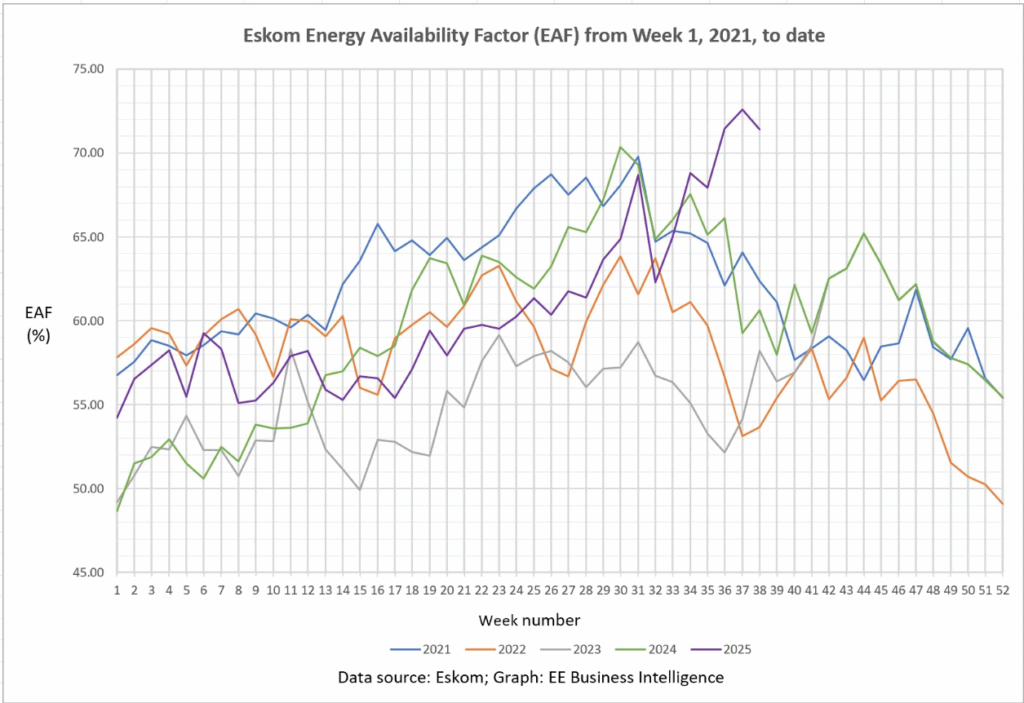
Eskom’s energy availability factor (EAF) is at a four-year high and is exceeding the 70% target set by the board for its generation fleet.
This is the first-time the utility’s fleet has sustainably passed the 70% target since it was first set by the board as part of its turnaround plan.
Eskom’s surging EAF is coupled with a slight reduction in planned maintenance year-on-year and a significant reduction in unplanned outages.
Energy expert and managing director of EE Business Intelligence, Chris Yelland, praised the utility’s performance in releasing the latest data.
“This is a very significant and dramatic operational performance improvement indeed. Well done to the Eskom Generation team lead by Bheki Nxumalo,” Yelland said in a social media post.
Eskom’s improved operational performance is likely to translate into a much healthier financial result in the current financial year due to immense savings on diesel and higher tariffs.
The utility’s performance has improved substantially since the implementation of the Generation Recovery Plan in March 2023.
This plan was effectively about short-term gain for long-term pain, with the utility spending heavily on diesel to provide space for it to conduct intense maintenance of its coal-fired plants.
The strategy has borne fruit for the utility, with a significant improvement in the performance of its ageing coal fleet over the past two years.
This has been coupled with the replacement of the two steam generators at Koeberg, several Kusile units coming online, and the return of Medupi Unit 4.
The addition of these units, in some cases their return, has significantly boosted Eskom’s generation capacity and have been critical in relieving pressure on older units.
Apart from Eskom’s operational improvements, significant investment from the private sector has led to skyrocketing renewable energy generation.
This helped alleviate pressure on Eskom and enabled it to build reserves for the evening peak and conduct maintenance on its plans.
Eskom’s improved performance can be seen in the graph below, courtesy of Yelland, which shows the substantial rise in the utility’s EAF in 2024 and 2025.
Eskom’s playbook
Eskom’s chairman, Mteto Nyati, and Electricity Minister Kgosientsho Ramokgopa have explained how the utility’s performance has improved in recent years.
Furthermore, they have said it provides a template on how South Africa’s other ailing state-owned enterprises can be saved.
While much of this progress is down to the Eskom-specific Generation Recovery Plan, chairman Mteto Nyati believes there are lessons for all SOEs in the utility’s recovery.
Eskom’s turnaround has been impressive, with it recording an energy availability factor (EAF) of 48% in early 2023. Just over two years later, its EAF is sitting at above 70%.
“We need to take a step back and look, in general, at how we can turn around SOEs in South Africa,” Nyati said.
“The starting point is to have a board that is fit for purpose and has experience in dealing with the challenges facing that entity. That is what we have at Eskom.”
Nyati admitted that this is heavily dependent on having the right minister in charge of the SOE, as they have the final say in who is appointed to the board.
“That was great work done by the ministry to make sure that they appointed people whose experiences speak to the problems of Eskom,” Nyati said.
“Then that board has the responsibility of building a leadership team that, again, has a good understanding of the environment Eskom operates in.”
He explained that this can take time. For example, Eskom’s board took over six months to find the right CEO in Dan Marokane.
Crucially, Marokane had experience working at Eskom and the broader electricity sector, giving him a natural advantage in knowing what needed to be done at the utility.
“But, you also need to have a board that holds the leadership team accountable. We had a two-year turnaround plan, and we held them accountable in implementing that plan,” Nyati said.
“When things did not work out, you have to be open about it and hold people accountable. You have to say, ‘You were supposed to do X and you did not do it’.”
Nyati admitted that the utility failed to reach its target of an EAF of 70% by the end of March. Eskom has now reached this point, a few months later.
“All elements of the equation have to work together from the Ministry to the board to the leadership team and the management team working directly with the individuals on the ground,” Nyati said. “All of that is important, and that is what we have at Eskom.”
Ramokgopa said it is not enough to have individuals with the right skills in the right positions, as these skills have to be relevant to the challenges the company faces.
In the past, Eskom did not have this when it was led by former CEO Andre de Ruyter, with Ramokgopa believing that the utility made a poor choice in appointing him to the top job.
“I think we misdirected ourselves previously when we got someone at the helm who does not have an appreciation of how to run a utility of this nature,” he said.
Ramokgopa explained that Eskom has designed a template for resuscitating and rescuing South Africa’s ailing SOEs.
“Obviously, the nuances will be different moving from one SOE to another, with each having a unique mandate and some specific challenges. But all have high-level problems that are similar,” Ramokgopa said.




Comments