Capitec changes its name – and it is much more than just a bank


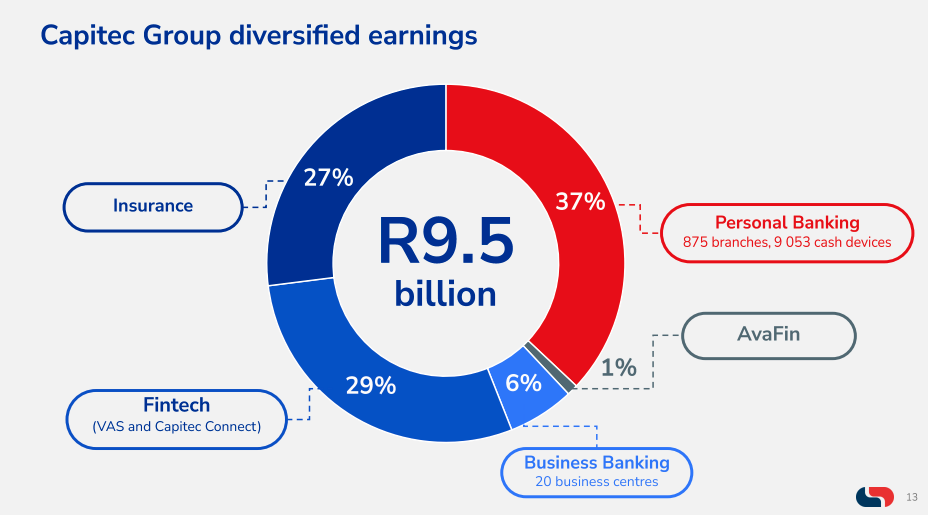
Capitec’s expansion beyond banking continues to gain momentum, with its non-banking income making up the majority of its headline earnings in the first half of the 2027 financial year.
This is largely thanks to Capitec’s ability to increasingly sell value-added services, such as Capitec Connect, and its insurance offerings to its banking client base.
It is also due to non-banking businesses being highly profitable and efficient relative to lending, which consumes substantial capital.
Capitec’s interim results for the first half of its 2027 financial year show this trend in full effect and give meaning to its name change from Capitec Bank Holdings to Capitec Limited.
In the results booklet, Capitec’s management team said this new name “reflects our growing focus on delivering a wider range of value-adding solutions ot our clients”.
This is evident in the numbers, with Capitec’s headline earnings surging 19% to R9.5 billion, accompanied by an industry-leading return on equity (ROE) of 31%.
For comparison, while many of its Big Four peers generate significantly higher headline earnings, these earnings are often accompanied by an ROE below 20%.
This is powered by Capitec’s growing non-banking business, which now makes up the majority of its headline earnings.
Net non-interest income rose 21% to R16.1 billion and contributed 70% of Capitec’s operating income after credit impairments.
This growth was driven by the bank’s value-added services and Capitec Connect, with this segment’s operating income jumping 32% to R3.8 billion.
Capitec’s insurance business continues to go from strength to strength, with net insurance results increasing by 28% to R3 billion.
All of this revenue is fee-rich, making it extremely lucrative for a bank, as it does not consume capital in the same way that lending does.
Net interest income, in contrast, grew by 7% to R12.7 billion. Notably, Capitec’s personal banking lending book crossed R100 billion for the first time.
However, Capitec’s credit impairments rose by 21% to R5.75 billion. This pushed its credit loss ratio up to 8.4% from 7.9% a year earlier.
Capitec said this was driven by higher forward-looking provisions following geopolitical conflict and higher interest rates in South Africa.
Thanks to Capitec’s non-banking business, its operating expenses grew at a far lower rate than its headline earnings.
Operating expenses increased by 5% to R10.5 billion, resulting in Capitec’s cost-to-income ratio improving to 36% from 40% a year earlier.
For context, some of its Big Four peers have cost-to-income ratios above 50% thanks to their reliance on lending and other banking activities.
Capitec’s strong financial performance enabled it to declare an interim dividend of R31.10 per share. This is an increase of 19% year-on-year.






Comments