134-year-old South African company’s liquidation puts historic industry on the edge


Tongaat Hulett’s liquidation would put South Africa’s sugar industry on the brink of collapse, with spillover effects that could crush any hope of faster economic growth.
Lying at the heart of South Africa’s sugar industry, Tongaat Hulett has the capacity to mill two million tonnes of sugar and indirectly supports tens of thousands of jobs.
While the company was marred by an accounting scandal in 2019, the reasons for its potential liquidation are more fundamental.
The local sugar industry simply cannot compete with cheap imports from Asia into South Africa, Remgro CEO Jannie Durand recently told 702.
Durand called on the government to step in and save Tongaat Hulett by protecting the broader industry through tariffs on imports or subsidies for the local sector.
Remgro owns a majority stake in one of Tongaat Hulett’s biggest competitors, RCL Foods, which has been shielded from the worst effects of cheap imports by its diversified offering.
“We are very supportive of tariffs on imports. It can be seen in what is playing out in KwaZulu-Natal with Tongaat Hulett,” Durand said.
“They are a competitor, but it is not a good thing if they go into liquidation. About 200,000 people depend on the sugar industry in that province and, as we speak, they cannot make money.”
Durand explained that sugar producers cannot sustainably sell sugar at current market prices, which have been driven down by cheap imports.
“At current sugar prices, they cannot make money. The mills are not even running. The growers are struggling. It is at a tipping point at the moment,” Durand said.
“The problem is not that we are not an efficient producer of sugar in South Africa. We convert sugar very efficiently, but we are getting flooded by cheap imports out of India and Brazil.”
Producers in those countries are subsidised by their governments, enabling them to produce sugar at significantly discounted, unsustainable prices.
In South Africa, sugar producers receive no subsidy, which means that they cannot compete on a level playing field.
Durand said the only way to rectify this problem sustainably is to implement tariffs on imports, which will make sugar slightly more expensive but keep a vital industry alive.
Tongaat Hulett’s collapse

Founded in 1892, Tongaat Hulett has become one of the most iconic companies in South Africa, with its sugar being a household name.
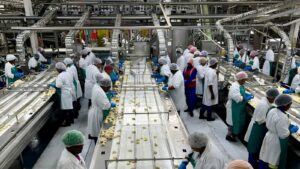
Named after the uThongathi River in KwaZulu-Natal, the company operated three mills with the capacity to crush more than 4.8 million tonnes of cane a year.
These mills no longer run at full capacity, largely because of the rise in cheap imports and declining sugar consumption in recent years.
Tongaat Hulett also operates in Botswana, Mozambique, and Zimbabwe, supporting close to half a million livelihoods.
The company’s collapse, despite the role of cheap imports, cannot be separated from the accounting fraud scandal that emerged in 2019.
Following the fraud’s revelation, the company suffered a disastrous downfall, with around R12 billion in shareholder value being destroyed.
It became clear that the company’s former management team engaged in serious accounting irregularities, including financial misstatements, and oversaw significant governance failures.
This pushed Tongaat Hulett to enter voluntary business rescue in 2022, suspending its shares on the JSE and giving it space to implement a turnaround plan.
A formal turnaround plan was adopted by stakeholders in January 2024, which involved Robert Gumede’s Vision Group consortium.
The Vision Group had agreed to acquire R11.7 billion of the company’s debt by using financing from the Industrial Development Corporation (IDC). The debt was held by Investec, Absa, and Nedbank.
Using a debt-to-equity restructuring, the Vision Group consortium would have taken over control of the company and saved it from liquidation.
This initial plan was not supported by shareholders, and a Plan B was drawn up that would see Vision acquire the company’s operations in South Africa, Zimbabwe, Mozambique, and Botswana.
While this appeared promising, Vision introduced new demands and conditions during negotiations with the IDC to secure financing for the acquisition.
“These included funding requirements beyond the financing of the IDC PCF facility and the SASA escrow amount,” Tongaat Hulett’s business rescue practitioners said.
“These demands materially complicated and delayed discussions between Vision and the IDC as well as the implementation of the plan at a time when Tongaat’s liquidity position was under severe pressure.”
As a result, the practitioners concluded that there was no reasonable chance of saving Tongaat Hulett and applied for its liquidation.
The Department of Trade, Industry, and Competition has since said it would oppose the liquidation in court. It does not have the power to stop the liquidation, but it can make a case against it.
“It’s most unfortunate that the Vision business rescue plan has been allowed to fail,” Vision Group member Robert Gumede told Bloomberg. “However, Vision shareholders are still committed to saving Tongaat South Africa.”



Comments