Eskom’s turning the corner after receiving R460 billion of taxpayer money


Eskom has reported some positive improvements in terms of its finances, including a significant reduction in its borrowing.
The power utility met with the Standing Committee on Appropriations (SCOA) on 24 March 2026 to present an update on their financial plan for the 2026/27 fiscal year.
One of the topics discussed was Eskom’s Debt Relief Programme, with the utility stating that stabilising its debt burden is one of its main goals over the next few years.
Eskom has received a cumulative R460 billion in debt guarantees from the government and the National Treasury over the last decade, with a further R10 billion to be granted in 2029.
Significant portions of these guarantees stem from two separate debt relief programmes – the Special Appropriation Act of 2019 and the Eskom Debt Relief Act of 2023.
The first granted over R158 billion in support to Eskom from 2019 to 2023, with the second granting an additional R230 billion over a six-year period beginning in July 2023.
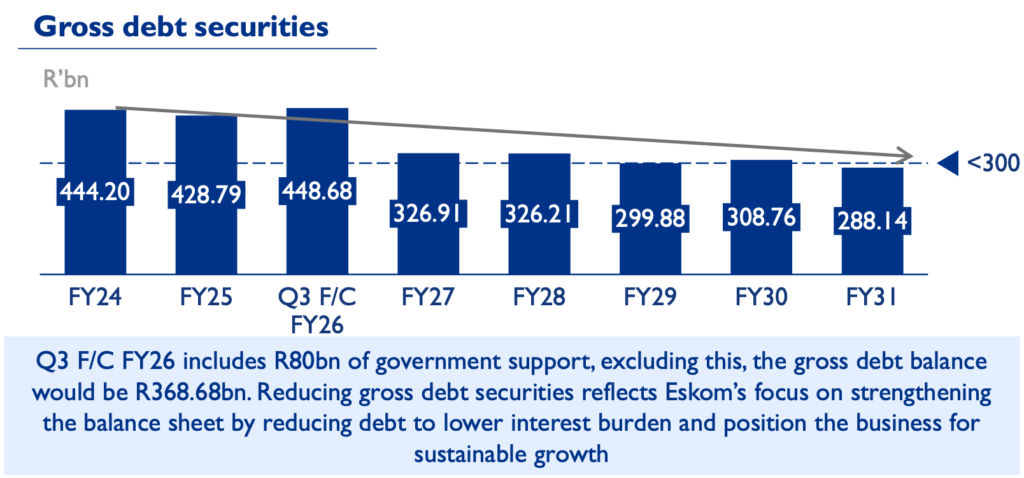
During its meeting with SCOA, Eskom reported its current debt securities at R359.6 billion, down from R410 billion the year before.
The utility said the R50.4 billion decrease is the first step in Eskom’s plan to significantly reduce its dependence on the government for support.
Members of SCOA expressed satisfaction with Eskom’s improvements, with chairperson Dr Mmusi Maimane describing it as something worth celebrating.
“It speaks to the fact that even some of the rating agencies have begun to improve on Eskom’s financial status,” Maimane said. “But also as a committee, as we dealt with the special appropriation for Eskom’s debt relief.”
“It speaks inherently to the fact that even as we passed it last year, their finances indicated that they would need the fiscus to be able to underpin their financial position.”
Eskom aims to further reduce its state dependence over the next five years, projecting gross debt securities of R288 billion by 2031.
A threat to Eskom’s progress
Eskom’s improving financial performance has not been without its difficulties, with the utility stating that rising municipal debt remains one of its biggest challenges.
As of December 2025, South Africa’s municipalities reportedly owed Eskom a collective R110.5 billion in municipal debt.
If left unchecked, this number is expected to grow to R358 billion by 2031 — an increase of over 220% from its current value.
In 2023, the National Treasury launched a Municipal Debt Relief Programme to assist struggling municipalities in paying off their outstanding debts to Eskom.
During Eskom’s meeting with SCOA, the utility stated that only 10 of the 71 municipalities in the debt relief programme are compliant with paying their current accounts.
Eskom said that it is partnering with the government to curb rising debt levels through other avenues, such as distribution agency agreements (DAAs).
Municipalities that enter into a DAA with Eskom will effectively transfer their distribution power over to the state-owned utility.
Eskom recently initiated legal action against 14 municipalities in arrears, threatening to suspend their power supply if they do not settle their debts or enter into a DAA.
One municipality has since agreed to a payment plan, with the City of Ekurhuleni settling half of its R3.4 billion debt immediately and agreeing to pay the rest over the next 18 months.
Organisations such as AfriForum and the South African Local Government Association (SALGA) have challenged Eskom’s plan to cut power in these municipalities.
“The reality is that consumers themselves are facing difficulties,” Maimane said. “SALGA makes the point that municipalities are facing debt of over R400 billion.”
“They are not able to recoup that cost, and much of it is government departments who are not paying. Ultimately, it means they themselves cannot honour the debt that they need to give over to Eskom.”
Maimane has called for restructuring the country’s municipal finance system and increased support for indigent communities, who are contributing to the debt burden.

 Loading ...


Comments