South Africa’s biggest bank benefitting from Trump’s tariff volatility


Standard Bank’s Corporate and Investment Banking (CIB) division saw its trading revenue jump 20% year-on-year in the first six months of 2025.
This is largely due to increased client activity amidst elevated market uncertainty, with the division benefitting immensely alongside its global peers.
The bank revealed this in its interim results presentation, where CFO Arno Daehnke explained some of the drivers behind the strong growth of its investment banking arm.
Standard Bank’s CIB division continues to perform strongly, making up half of the group’s R23.8 billion in headline earnings for the first half of the year.
It also reported a record R123 billion in investment banking origination, driven by increased investment in the energy and infrastructure sectors.
A hidden bright spot for the division came from its trading revenue and global markets revenue, which are highly dependent on client activity.
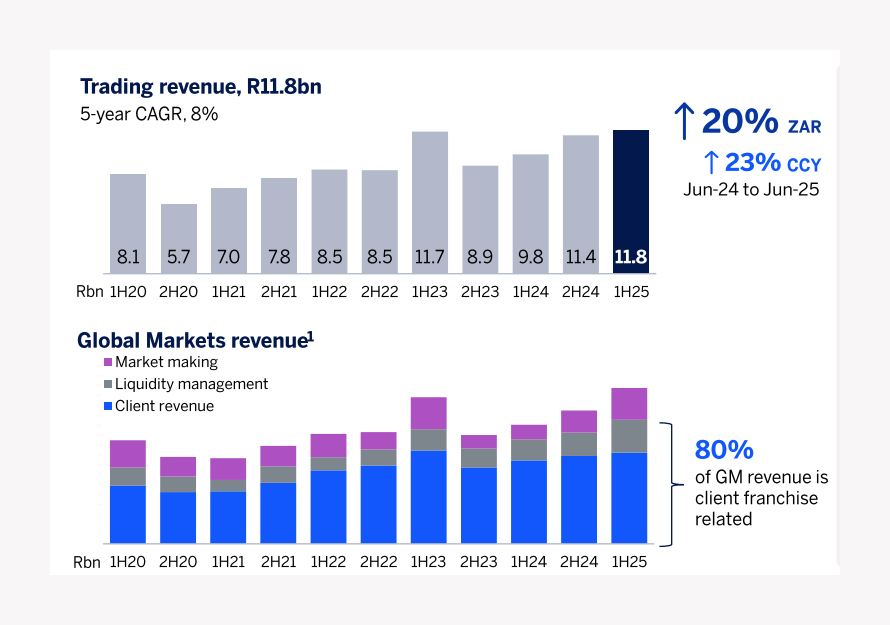
Trading revenue grew 20% in rand terms to R11.8 billion for the first six months of the year, while global markets revenue, which comes from market making, liquidity management, and client revenue, grew strongly as well.
Daehnke explained that this growth was largely driven by increased client activity stemming from elevated uncertainty and volatility.
Financial markets have been roiled by volatility in the first half of the year following the apparent overhaul of US trade policy, which involved the imposition of tariffs on imports into the country.
Locally, markets have also been impacted by uncertainty regarding the future of the Government of National Unity (GNU) and the potential for a lower inflation target for the central bank.
The strong performance of the JSE All Share Index, which has so far outpaced the S&P 500 in 2025, has also driven increased trading activity.
All of these factors benefit investment banking, with Standard Bank noting strong client demand for fixed income, commodities, and equity trading.
Its fixed-income operations benefited from demand for credit-linked, structured heading, and financing solutions in South Africa and from demand for foreign exchange solutions in West Africa.
Commodities revenue grew as market fluctuations resulted in increased opportunities to provide client hedging solutions, Daehnke said.
On the other hand, equity trading revenue grew strongly on the back of improved investment appetite and liquidity. Market uncertainty also drove client activity at the bank and trading opportunities.
The growth in trading revenue and the division’s global markets division can be seen in the graph below.
Volatility drives exchange revenue
The strong performance of Standard Bank’s CIB division over the first half of the year is indicative of the benefits financial institutions derive from increased activity.
Other banks have noted a pickup in client activity amid heightened volatility, while the Johannesburg Stock Exchange (JSE) has seen a notable pickup in trading.
The company operating the JSE, the JSE Limited, reported higher revenue and profits in the first six months of 2025.
This was driven by a strong performance in its Capital Markets division, largely a result of equity trading, as uncertainty and volatility resulted in increased activity.
These results revealed a strong performance for the company, with revenue growth of nearly 12% to R1.65 billion and net profit growth of over 13% to R558 million.
The company’s operating income grew by 11.4% to R1.71 billion in the six-month period, primarily supported by equity market revenues.
Its Capital Markets division posted a particularly strong performance on the back of increased equity trading, with revenue growing by 28% to R272 million.
The JSE explained that this increased trading activity also came with higher costs, although these expenditures were carefully managed over the period.
Total operating expenditure increased by 7.5% to R1.09 billion amid increased trade-related costs. Around 1.56% of this increase relates to costs linked to higher trading activity.
“The bourse’s growth was driven by elevated equity market activity, supported by broad-based revenue growth across the core business, demonstrating high quality of earnings underpinned by diversification,” it said.
This strong performance marks a shift for the JSE, which has undergone a difficult period with delistings and a stagnant local economy weighing on the bourse.
The number of companies listed on the JSE has more than halved over the past twenty years, with around only 100 companies being tradable by large asset managers.
It has also suffered from the crowding out of private sector debt by the government, which has issued trillions of new debt in the past fifteen years to cover its fiscal deficits.
 Loading ...





Comments