Capitec is going after rich South Africans earning more than R50,000 per month



Following decades of dominance in the mass market, Capitec’s next phase of growth will see the bank target higher-income clients earning more than R50,000 per month.
This LSM segment forms an important part of Capitec’s future growth, with the bank already boasting 26.6 million customers.
The majority of Capitec’s existing customers are not high-income earners, with the bank now seeking ‘differentiation without discrimination’.
This was how Capitec CEO Graham Lee described the bank’s customer acquisition strategy going forward at its interim results presentation in September.
“At Capitec, what we build is for everyone. We don’t discriminate. What we don’t do is create something exclusive just for a few: we differentiate without discrimination,” Lee said.
This strategy is what led Capitec to become South Africa’s most valuable bank and the lender with the biggest customer base.
Starting off as a micro-lender in the early 2000s, Capitec offered loans and banking services to those who had been unable to access either from the country’s traditional banks.
This served Capitec well, allowing it to become a challenger and later surpass those incumbent banks.
However, targeting higher-income consumers will require Capitec to expand its offering.
The low fees and accessibility that drew in its millions of mass-market customers are not what tends to attract affluent customers.
In fact, wealthy South Africans have shown a willingness to pay up to 100 times more for a bank account than Capitec’s universal monthly fee of R7.50.
For example, one of the most expensive bank accounts in South Africa is Discovery’s Purple Suite, which requires customers to have a gross annual income of at least R2.5 million.
This account comes with a bank fee of R730 per month, excluding transaction charges, plus an annual card fee of R4,250.
Many higher-income South Africans are willing to pay for the exclusivity and personal service that comes with such a hefty fee.
Aside from exclusivity, wealthy South Africans also care more about, and make greater use of, the rewards and value-added services associated with their bank accounts.
This also makes them lucrative customers, as higher-income South Africans are more likely to hold more products, including transactional accounts, credit cards, insurance, and loyalty programmes.
Capitec’s strategy to capture South Africa’s wealthy
Capitec is sticking to its guns on offering one universal account with a flat fee to all customers, regardless of income.
Therefore, to attract wealthy customers, it has chosen to expand its value-added services (VAS) and rewards programme.
In the first half of its 2027 financial year, Capitec’s VAS segment boasted 13.5 million clients, up 14% year-on-year.
Together with Capitec Connect, this segment now accounts for 29% of the group’s R9.5 billion in headline earnings.
One major play Capitec has made to expand its offerings to higher-income South Africans is the travel benefits associated with its credit card.
With a Capitec Credit Card, customers receive airport lounge access and free international travel insurance up to R5 million.
They also pay no international currency conversion or forex fees, earn 1% cash back on all card spend, and are offered special flight discounts through partners like Travelstart.
Since international travel is normally the purview of the wealthy, this offering – which Capitec describes as the best in the country – is clearly aimed at higher income earners.
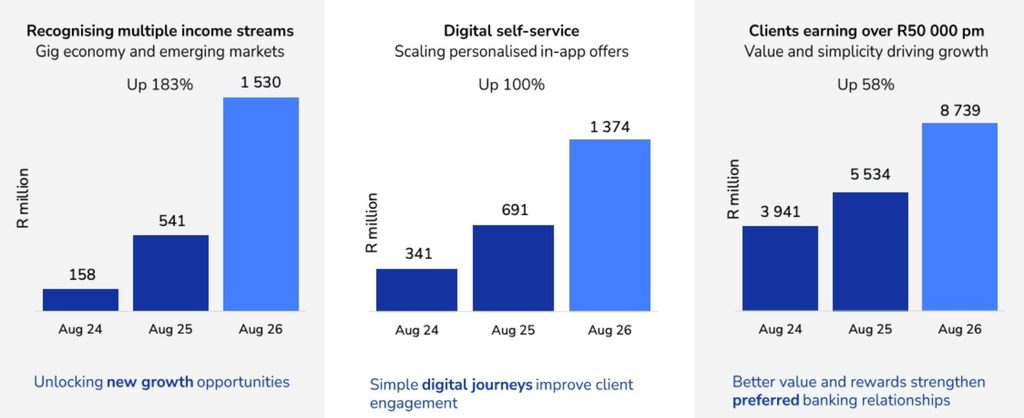
This strategy appears to be paying off. Capitec reported a 22% year-on-year increase in its number of high-earning clients for the first half of the 2027 financial year.
This makes high-income earners, which Capitec defines as those earning more than R50,000 a month, one of the bank’s top growth segments.
Capitec also reported that its lending to clients in this segment rose by 58% year-on-year, reaching R8.74 billion.
In the interim results presentation, Capitec Personal Bank executive Basani Maluleke acknowledged that this growth is largely attributable to its credit card offering.
“This is a story mostly of our credit card. The sales in this area have predominantly been driven by growth in the take-up of that credit card,” she said.
“That’s predominantly because our credit card has been positioned as the best credit card to travel with, and that is particularly attractive to clients in that market segment.”






Comments