Nedbank kicks off new era with a R14 billion bang


Nedbank has submitted an offer to acquire 66% of NCBA Group, one of East Africa’s leading financial services providers, for R13.9 billion.
This acquisition marks the first of CEO Jason Quinn’s tenure and is part of the bank’s reworked African strategy after it sold its stake in Nigerian lender Ecobank for R1.8 billion in late 2025.
Nedbank’s new African strategy is based on a clear focus on the Southern African Development Community and East Africa. It has also made it known that its future expansion in Africa will be in businesses it owns and fully controls.
The successful completion of the transaction will result in NCBA becoming a subsidiary of Nedbank, while the remaining 34% of NCBA shares will continue to trade publicly on the Nairobi Securities Exchange.
The proposed consideration will be structured as 20% cash portion and 80% new Nedbank ordinary shares listed on the Johannesburg Stock Exchange (JSE).
Quinn said the proposed acquisition represents a milestone in Nedbank’s strategy to grow its southern and East African footprint.
“The proposed deal brings together two organisations with highly complementary strengths,” Quinn explained.
“NCBA offers a strong brand presence, an extensive regional network, advanced digital capabilities, and deep customer reach, which aligns with Nedbank’s established Corporate and Investment Banking expertise, cross‑border structuring capabilities, and strong balance sheet.”
“By combining NCBA’s substantial local presence and Nedbank’s capital base, expertise, and enduring commitment to Africa, we see a compelling platform for sustainable growth in the region.”
Nedbank has long identified East Africa as a region of significant strategic importance, underpinned by strong macroeconomic fundamentals, the size of its economy, and a large and growing population.
This is coupled with the region seeing immense growth from being the primary trade corridor that links Africa with the Middle East, India, and Asia.
“We look forward to building a partnership that supports NCBA’s and our clients’ growth trajectories. This will further support economic development across the region while delivering attractive returns for all shareholders,” Quinn said.
NCBA will remain independently governed and retain its brand, local leadership team, and NSE listing. As Nedbank currently operates only a representative office in the region, no in‑country operational integration is required.
NCBA, headquartered in Nairobi, operates across Kenya, Uganda, Tanzania, Rwanda, and offers digital banking services in Ghana and Ithe vory Coast.
Formed in 2019 through the merger of NIC Group PLC and Commercial Bank of Africa Limited, NCBA serves more than 60 million customers and has 122 branches, a strong digital lending franchise,a nd a robust regional network.
It has an established reputation for innovation, advanced digital banking services, excellence in asset finance, investment banking expertise, and a strong regional presence.
NCBA now manages KES 665 billion (R84.4 billion) in assets, disburses more than KES 1 trillion (R126.9 billion) in digital loans annually, and has delivered an average return on equity of approximately 19% since 2021.
The transaction is subject to approvals and is expected to be concluded by the third quarter of 2026.
End of an era of pain

This transaction seeks to avoid some of the missteps identified with Nedbank’s foray into West Africa through its investment in Ecobank.
The sale of its 21.2% stake in Ecobank has been approved anf finalised, with Nedbank getting R1.8 billion in proceeds.
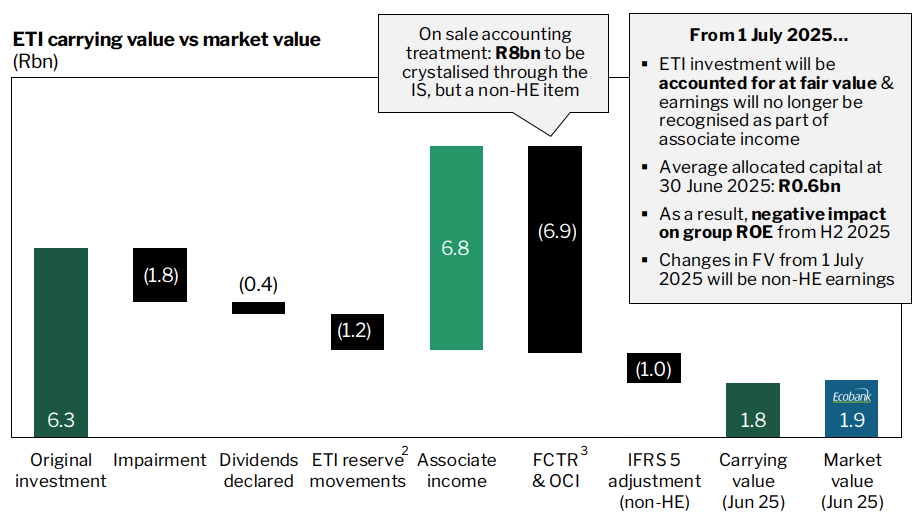
Nedbank had initially pumped R6.3 billion into Ecobank and has not seen much in the way of rewards over the past few years.
In the bank’s most recent interim results presentation, CEO Jason Quinn admitted that the bank’s investment case did not materialise as expected.
In particular, Quinn said that the performance of the Nigerian economy did not prove to be as strong as originally expected.
Operating in Nigeria also proved to be more difficult than initially anticipated, with Nedbank facing elevated regulatory uncertainty.
Quinn bemoaned ongoing regulatory recapitalisation requirements at the bank’s interim results in early August, which created a scenario where Nedbank would have to inject capital to prevent its shareholding being diluted.
“We wish to express our gratitude for the professionalism and integrity with which the board of directors of ETI have consistently conducted its affairs, and for the constructive engagement that has underpinned our relationship,” Quinn said.
“The ETI board’s stewardship has played a pivotal role in navigating ETI through complex environments and in advancing its pan-African mandate.”
“The sale represents a reset of Nedbank’s strategy on the rest of the African continent with a clear focus on the SADC and East Africa regions in businesses Nedbank owns and controls, and areas where we can play to our strengths.”
Nedbank CFO Mike Davis went into more detail regarding the financial benefit of Nedbank’s stake in Ecobank during the interim results presentation.
Davis showed that Nedbank initially invested R6.3 billion into Ecobank, with its market value now being a mere R1.9 billion.
This sharp decline in the market value of Nedbank’s stake in Ecobank can be seen in the graph below.






Comments