South African banks rolling out new branches – except for one


South Africa’s traditional ‘Big Four’ banks of Absa, Standard Bank, FirstRand (FNB), and Nedbank have significantly reviewed and overhauled their branch networks in recent years.
In response to rising adoption of digital banking channels and transactions, there has become less of a need for extensive physical infrastructure to serve clients.
However, while this is true, the majority of these banks see continued use in having an extensive branch network and are looking to expand their points of physical presence.
It appears as though ATMs are bearing the brunt of the shift away from physical transactions towards digital alternatives, with branches still playing a key role in cash transfers and client service.
The exception to this is Nedbank, which has closed more branches than it has opened in the past few years as it adopts a strong digital pivot.
While the majority of South Africa’s biggest banks are opening new branches, they are carefully reviewing their branch layout and design.
Bank branches are becoming smaller, with these banks only having a few full-service branches that incorporate all of their offerings.
Depending on client demand and usage, these branches may or may not include foreign exchange services, for example.
As branches become smaller and more everyday transactions occur digitally, the staff mix at these physical points of presence has also changed over time.
Banks are shifting towards having fewer, higher-skilled employees at their branches to assist with transactions and activities that cannot be done online and are more complicated.
This may include sophisticated insurance offerings, hard foreign exchange conversions, financial advice, and more advanced banking products, such as business banking.
Therefore, bank branches in South Africa are changing significantly as these banks overhaul and expand their networks to serve client demands.
Nedbank becomes a real outlier when one adds the biggest challenger to these banks, Capitec, which continues to grow its physical presence in South Africa rapidly.
Daily Investor reached out to the Big Four banks to understand why they are expanding or shrinking their branch network and how the services offered are changing.
Their responses are outlined below in detail, alongside the changes to their number of branches over the past year and three-year period.
Absa

Absa told Daily Investor its distribution network is undergoing an extensive transformation to support its future-fit operating model and meet client demands.
The bank’s branch network has remained broadly stable over recent years, increasing by two branches to 618 outlets as of the end of June 2025.
This is roughly the same number of branches the bank had three years ago, with Absa saying it has repositioned and relocated some of its physical infrastructure.
“Our branch network has evolved in recent years in response to changing customer preferences and the growing demand for convenience and digital self-service,” a spokesperson said.
“Many routine, non-empathetic transactions are now conducted efficiently through our self-service kiosks, including ATMs, and digital platforms.”
Despite this shift, Absa said it remains deeply committed to providing a human-centred service experience for its clients.
This is particularly true in what the bank terms “empathetic service”, which may include personally sensitive topics such as funeral, life, and other forms of insurance.
As a result, Absa’s branches now combine digital and physical touchpoints to be able to serve clients more efficiently and effectively.
This, it said, is in response to customer usage trends and preferences, which are increasingly digital, forcing the bank to change its branch layouts.
“This has resulted in the calibration of the branches for an optimal mix between traditional full-service branches and sales and service outlets,” it said.
The table below shows the change in Absa’s branch network over the past year, with the bank beginning to expand its physical infrastructure once again.
| Measure | 30 June 2024 | 30 June 2025 | Difference |
| Number of branches | 616 | 618 | +2 |
Standard Bank

Standard Bank has significantly expanded its branch network over the past year, adding 16 branches across South Africa.
This gives it 642 points of representation in South Africa, excluding ATMs, with the bank forecasting a continued rollout of new branches to a total of 669 by December 2025.
“We continue to increase the number of our branches to align with our growth strategies and opportunities,” Standard Bank’s head of client coverage for personal and private banking in South Africa, Willie Chavalala, said.
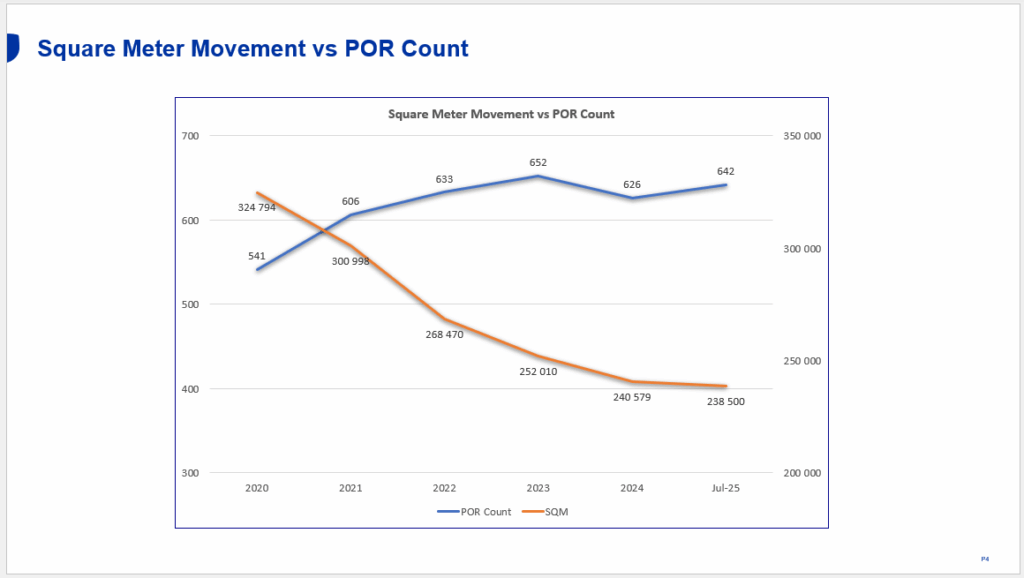
However, the bank’s branches continue to shrink in terms of floorspace, with it reducing the cash services offered in some of its branches due to changing client demand.
This enables the bank to reduce the size of its branches in certain parts of the country, while maintaining a growing number of cashless branches.
The new cashless branches will focus on sales, financial advice, digital services, and staff-assisted complex services.
“With cash volumes declining in some areas, we decided to review our branch network and streamline our footprint,” Standard Bank’s head of personal and private banking, Kabelo Makeke, said.
“Cash services have been consolidated into central branches with improved processing capabilities to enhance access, efficiency, and client experience.”
Nearly 90% of the bank’s cash deposits were received via non-branch channels, with 97% of withdrawals being made outside its branch network.
This has enabled it to roll out more cashless branches in South Africa, with 62 currently in operation. This has increased from only five branches in 2020.
Standard Bank also has 110 modular branches, which are also cashless. As a result, the size of its branches has shrunk by over 30% since 2020.
This has resulted in Standard Bank being able to change its staff mix at branches and employ more multi-service consultants and fewer cash consultants.
Standard Bank’s branch growth for the year to the end of August can be seen in the table below, with the graph comparing this to the size of the floorspace of the bank’s branches.
| Measure | January 2025 | August 2025 | Difference |
| Number of branches | 626 | 642 | +16 |
FirstRand (FNB)

FNB is another one of the Big Four banks that has expanded its branch network in recent years, opening 59 new branches in five years.
The bank has a total of 630 branches in South Africa and told Daily Investor that it expects to expand this network further in the coming years.
FNB Points of Presence chief operations officer Elmar Gräter said this is a balance the bank is striking to service clients across its bank.
“FNB continues to drive its branch growth strategy using statistical calculation and insightful data to ensure that its markets have sufficient representation,” Gräter said.
“The bank is determined to balance the optimisation of its branch operations with the demands and requirements of an area or region.”
As with the other banks, FNB has significantly changed its branch design to allow it to better serve its customers’ needs.
“Our branches are regularly revamped and refreshed with the latest design specifications, ensuring both staff and customers have an optimal experience,” Gräter said.
Some of its branch improvements include semi-private booths for staff or service advisors to assist customers one-on-one, service desks for telephonic queries or pods for the usage of digital channels.
The growth in FNB’s branch network over the bank’s past financial year can be seen in the table below.
| Measure | 30 June 2024 | 30 June 2025 | Difference |
| Number of branches | 623 | 630 | +7 |
Nedbank

Nedbank is the exception among the Big Four banks, with it continuing to reduce its footprint across South Africa in recent years.
In 2025, the bank has closed one branch so far, adding to the four closed in the previous year. Since 2020, Nedbank has reduced its footprint by seven branches.
“Over the years, we have witnessed a significant shift in how our clients interact and transact with us, primarily driven by the growing adoption of our digital solutions,” Nedbank Integrated Channels executive Dave Schwegmann said.
The bank’s declining branch footprint is part of Nedbank’s Project Imagine. Launched in 2020, the project aims to prepare its branch network for changes in client behaviour amid the shift to digital banking.
“While our Nedbank MoneyApp plays an important role in integrating the physical and digital experiences for our clients, we redesigned our branch layout to cater for specific client needs,” Schwegmann said.
“Our branches have self-service zones where our clients complete simple transactions on bank-owned devices, semi-assisted zones where our staff educate our clients on digital banking and fully assisted zones.”
The last branch to be converted will be Nedbank’s Secunda branch, which will shift to the Imagine format in November 2025.
Nedbank CFO Mike Davis explained this further to Daily Investor in an interview following the bank’s interim results in August.
“In South Africa, as a bank, you will always need a physical footprint that your clients can engage with, particularly if you want to offer a complete range of financial services,” Davis said.
He also said that despite the rise in digital transactions, a significant number of transactions still take place within a branch or at ATMs.
“Having said that, what you have seen Nedbank do is retain its points of presence, but reduce the size of its footprint,” he said.
“If you go back over the years, you will see that every branch and every point of presence was roughly the same size and offered the same services.”
“What you will see now is that through our relationship with Boxer and the rationalisation of certain points of presence, we still exist in the same places, but the type of facility has changed.”
“If we have a point of presence with a retailer like Boxer, it is manned by Nedbank staff, but it is very simple in terms of its value offering or proposition.”
“On the other hand, if you go into Sandton City, you will see a huge branch offering everything from transactional banking to stockbroking, asset management, lending, and deposit-taking.”
The table below shows the decline in Nedbank’s branch numbers over the past year.
| Measure | 30 June 2024 | 30 June 2025 | Difference |
| Number of branches | 515 | 514 | -1 |






Comments