Western Cape leaving Gauteng in the dust



Property prices in the Western Cape are pulling further ahead of Gauteng, with Cape Town recording significantly stronger growth and higher prices across different types of properties.
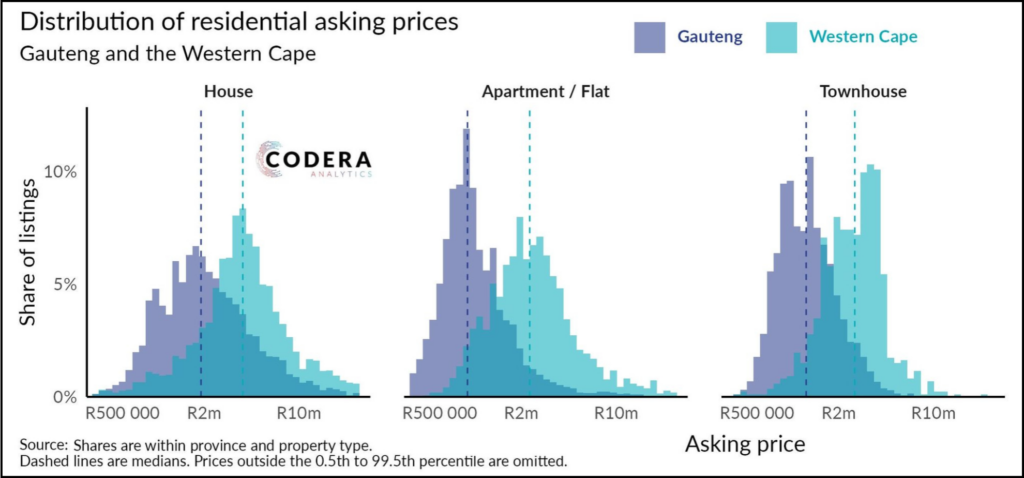
An analysis by Codera Analytics compared the distribution of residential property prices across suburbs in the two provinces.
It looked at houses, townhouses, and apartments, with Cape Town more expensive across all property types analysed.
The difference is also reflected in the broader property market. Statistics South Africa’s Residential Property Price Index showed that prices in the Western Cape increased by 11.2% year-on-year in May 2026, compared with 5.5% in Gauteng.
The Western Cape was the largest contributor to national property price inflation, adding 4.7 percentage points to the annual increase of 8.2%. Gauteng contributed 1.9 percentage points.
The figures point to a growing divide between the two provinces, with the Western Cape continuing to attract buyers and property investment.
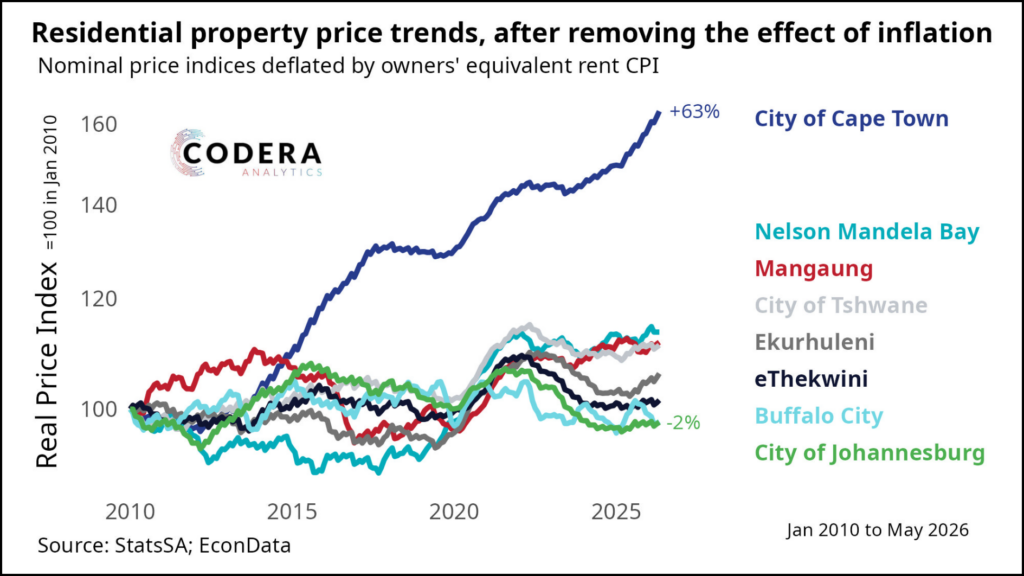
A separate Codera Analytics analysis by Aidan Horn examined residential property price developments across South Africa’s major metros from 2010.
It compared house prices with owners’ equivalent rents across eight metropolitan areas – Cape Town, Nelson Mandela Bay, Mangaung, Tshwane, Ekurhuleni, eThekwini, Buffalo City and Johannesburg.
Cape Town was the only metro to record a meaningful real increase in property prices over the period.
Its property prices grew by 63%, substantially more than any other metro included in the analysis. The comparison also showed that real house price increases were much smaller than increases relative to rent.
The stronger performance reflects several factors supporting demand in the Western Cape, including semigration, ongoing development and infrastructure.
Reliable municipal services are also closely linked to property market performance. Areas with more consistent water, electricity, road maintenance and other services can be more attractive to buyers.
This can support demand and property values, particularly when service delivery in other areas is less reliable.
Meanwhile, in Gauteng, concerns about municipal services and infrastructure have continuously put pressure on parts of the property market.
The rental market in the Western Cape vs Gauteng
Buyers are not the only ones feeling the difference in the Western Cape and Gauteng property markets. For renters, the gap between these areas is only growing.
The Western Cape is South Africa’s most expensive rental market, with average monthly rent reaching R12,561 in the second quarter of 2026.
This was an increase of R1,107 compared with the same period a year earlier, representing annual rental growth of 9.7%.
According to PayProp’s Q2 2026 Rental Index, the Western Cape’s average rent was R1,999 higher than the second-most expensive province, the Northern Cape.
The province also recorded its lowest-ever proportion of tenants in arrears, at 12.3%, despite the sharp increase in rental prices.
Earlier figures from PayProp’s Q1 2026 index showed average rent of R12,125 in the Western Cape, compared with R9,600 in Gauteng. This put the Western Cape more than R2,500 above Gauteng at the time.
Nationally, average monthly rent reached R9,715 in Q2 2026, following a 5.2% quarterly increase.
However, rental growth varied considerably across the country. Seven of the nine provinces recorded growth below the national average.
However, while the Western Cape may be one of the only regions seeing consistent growth, it isn’t necessarily the most attractive market for property investors.
A previous Codera analysis of property prices and rents by suburb found that Gauteng generally offers more affordable rentals across houses, townhouses and apartments.
It also indicated that properties in Gauteng can offer higher gross rental yields because purchase prices are lower relative to rental income.
For houses, a larger proportion of Gauteng properties could generate gross rental yields of around 8% or more, compared with Cape Town.
Apartment yields also tended to be higher in Gauteng, where lower property prices can make rental income more attractive relative to the initial investment.
These figures are gross yields, meaning they do not account for costs such as maintenance, rates, levies, insurance, vacancies or tax.
Log in or register for free access to all articles.






Conversation
1 commentsIs this really a good thing? Locals are getting priced out of their own city.