South Africa pays R1.21 billion a day and gets nothing in return



Despite a stabilisation in South Africa’s debt-to-GDP ratio, the country continues to spend R1.21 billion each day to service its debt.
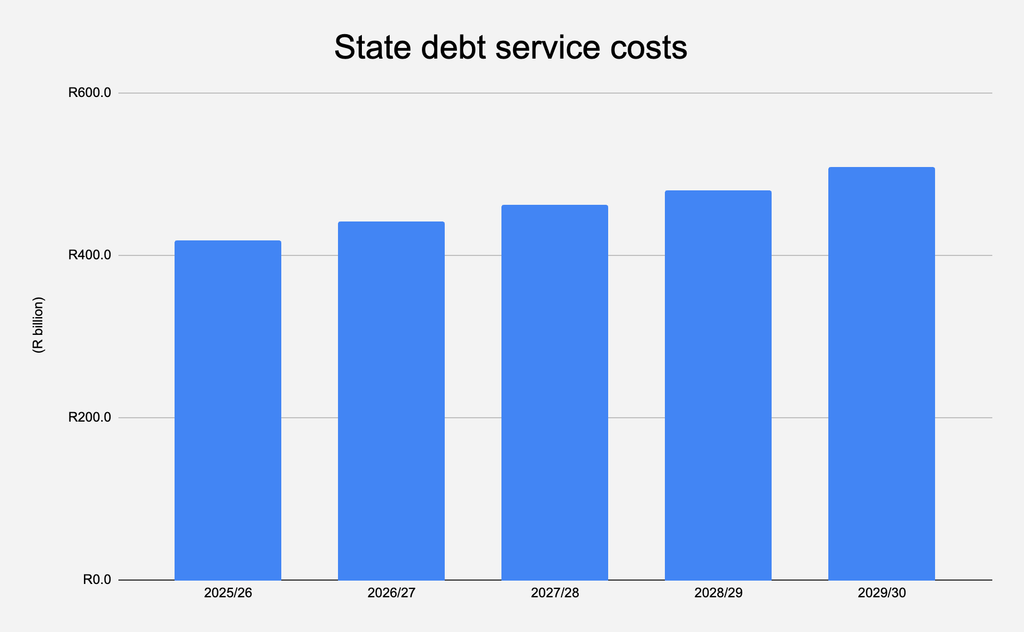
While the debt-to-GDP ratio is expected to decline in the coming years, debt-service costs are projected to reach R509.3 billion in 2029, or R1.4 billion a day.
This is non-productive spending that crowds out expenditure on line items such as education, infrastructure, and healthcare.
Investec chief economist Annabel Bishop said that, despite some progress, the state’s high debt costs remain a binding constraint on the country’s growth.
Bishop’s comments came after Finance Minister Enoch Godongwana delivered the 2026 Medium-Term Budget Policy Statement (MTBPS).
The MTBPS contained good news about South Africa’s fiscal health: the debt-to-GDP ratio remained stable, it achieved a primary budget surplus, and revenue exceeded expectations.
However, the MTBPS also revealed that the state’s debt service costs had to be revised upward by R9 billion compared to the February Budget.
The revision was triggered by a higher gross borrowing requirement and higher interest rates, driven by the war in Iran and rising global bond yields.
This means the government will pay R441.5 billion to service its debt in 2026/27, equivalent to 5.4% of South Africa’s GDP.
These costs are expected to rise over the medium term, reaching R509.3 billion in the 2029/30 fiscal year.
This is despite the debt-to-GDP ratio being expected to decline from 78.2% of GDP in 2026/27 to 76.6% in 2029.
To put this high cost into perspective: the government will spend more on servicing its debt than on basic education, health, or social development over the next three years.
Debt service costs consume 21 cents of every R1 of the government’s main budget revenue.
Even with the National Treasury projecting high revenue over the medium term, debt service costs are expected to remain stable as a percentage of revenue, at about 20.6%.
| Fiscal Year | Debt-Service Cost | Daily spend |
| 2025/26 | R417.9 billion | R1.14 billion |
| 2026/27 | R441.5 billion | R1.21 billion |
| 2027/28 | R462.5 billion | R1.27 billion |
| 2028/29 | R480.6 billion | R1.32 billion |
| 2029/30 | R509.3 billion | R1.40 billion |
A binding constraint
Bishop pointed to comments from credit rating agency Moody’s about South Africa’s MTBPS.
The agency said it expects South Africa’s debt to peak at 84.9% of GDP in two years’ time.
Moody’s warned that South Africa has low debt affordability, meaning the country has a weak ability to service its national debt obligations relative to its revenue and GDP.
Moody’s also pointed out that South Africa’s interest payments as a percentage of revenue are higher than those of most of its rating peers.
“Elevated debt service costs are the biggest binding constraint on the state, and so on fiscal consolidation,” Bishop said.
Fiscal consolidation has been South Africa’s chosen strategy to reduce its debt and improve the overall health of the fiscus.
To curb the growth of South Africa’s debt service costs and preserve fiscal sustainability, the National Treasury is employing three main levers.
The first is expanding the state’s primary surplus, which is what the government has left over after paying for everything except the interest on its existing debt.
The Treasury plans to grow South Africa’s primary surplus from 1.7% of GDP in 2026/27 to 2.9% by 2029/30.
It will do so by ensuring that its revenue exceeds its non-interest spending by a widening margin, thereby slowing debt accumulation.
The second lever is debt stabilisation, which the Treasury achieved in the 2025/26 fiscal year.
The state’s gross loan debt stabilised at 78.4% of GDP in 2025/26, and is expected to decline to 76.6% by 2029/30.
The final lever in the Treasury’s arsenal is active liability management, with the government having introduced a bond buyback programme.
This programme, launched in 2026/27, will allow the state to manage its refinancing risks and smooth out elevated bond redemptions over the medium term.
Login or register for unlimited free access.