South African government’s nasty R3 trillion surprise


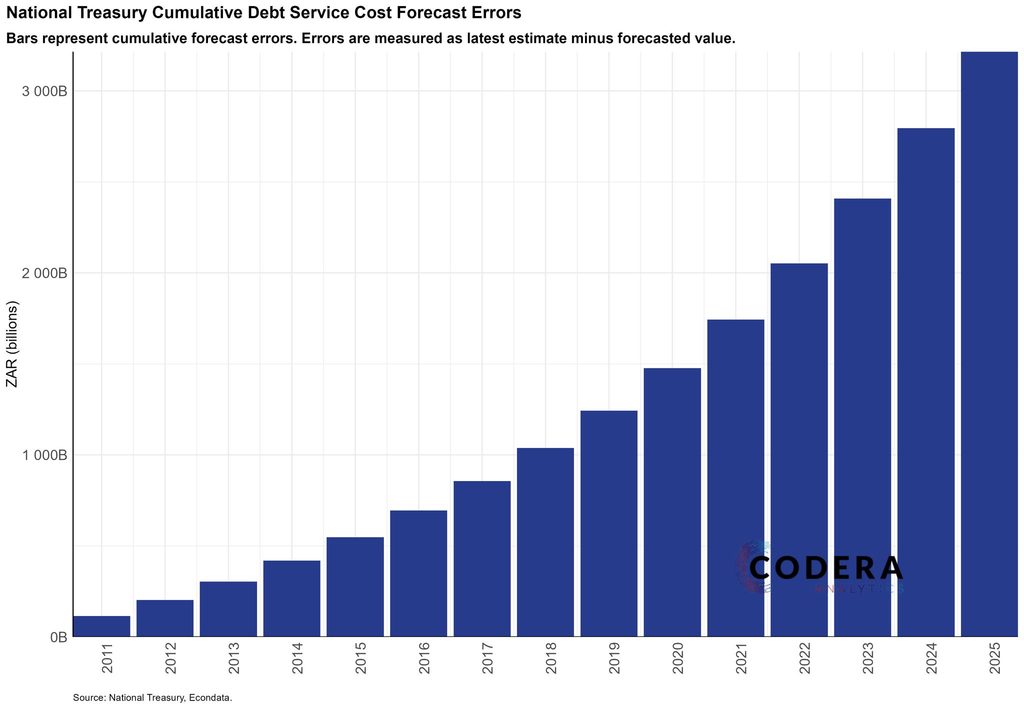
Cumulative revenue forecast errors over the last 15 years led the South African government to accumulate over R3 trillion in unexpected debt service costs between 2011 and 2026.
This was revealed in a recent blog post from Codera Analytics, demonstrating the compounding effects of past policy decisions on the country’s fiscal framework over the years.
The post draws from a paper previously published by Codera in May 2026 under the Southern Africa – Towards Inclusive Economic Development (SA-TIED) programme.
SA-TIED was launched in 2017 as a joint high-level research and policy partnership which uses anonymised tax data to guide economic decision making in South Africa.
Partners include the National Treasury, the South African Revenue Service (SARS), and the United Nations University World Institute for Development Economics Research (UNU-WIDER).
The paper, titled “Understanding fiscal slippage and fiscal forecast errors in South Africa”, was written by researchers Jan-Hendrik Pretorius, Lisa-Cheree Martin, and Daan Steenkamp.
According to their paper, South Africa’s debt service costs have played a central role in the country’s fiscal slippage since the 2008/09 financial crisis.
“Rising debt was associated with rising debt service costs over this period, even though the effective interest rate on government debt stayed relatively consistent,” the authors said.
“As a consequence of upside gross debt forecast errors, debt service costs have continuously exceeded expectations since 2012/13.”
The South African Reserve Bank revealed last year that debt service costs had risen by an average annual rate of 13.1% between 2008/09 and 2024/25.
During that same period, debt service costs rose from 2% of GDP to 5%, now representing one of the largest spending line items in the South African government’s budget.
Aside from 2020/21, when pandemic-related social transfers surged, debt service costs have been the primary driver in the deterioration of South Africa’s overall budget balance in recent years.
“A major contributor to annual budgetary slippage was the support for SOEs since the global financial crisis,” the paper said.
“The largest share of these bailouts went to Eskom, South Africa’s electricity utility, with all forms of support amounting to almost R500 billion since 2008/09.”
Reducing the debt burden
South Africa’s gross government debt is projected to amount to R6.33 trillion at the end of the 2026/27 financial year, representing 77.3% of GDP.
The annual debt service costs for this year are expected to reach R432.4 billion, equating to South Africa spending R1.18 billion every single day to service its debt.
This was revealed by Finance Minister Enoch Godongwana earlier this year in response to a parliamentary question from National Assembly member Emerald Madlala.
Madlala had asked the Minister to disclose what measures the Treasury had taken to reduce debt service costs without cutting funding to essential public services and programmes.
In his response, Godongwana said the National Treasury had implemented a number of different measures in order to reduce its debt service costs.
These included fiscal consolidation, bond-switch operations to reduce refinancing pressure, and increased use of concessional funding from multilateral institutions.
It also included the utilisation of Gold and Foreign Exchange Contingency Reserve Account transfers and cash balances to lower borrowing requirements.
Finally, Godongwana said the National Treasury was looking at optimising its debt portfolio and financing strategy.
Godongwana has made the stabilisation and reduction of government debt one of his key priorities as Minister of Finance.
During his latest Budget Speech in February of this year, he said that a clear reform agenda and disciplined fiscal strategy had begun to deliver results in this regard.
“For the first time in 17 years, debt will stabilise and it will continue to fall in the coming years,” Godongwana said. “The budget deficit has narrowed significantly, and debt-service costs are also falling.”
“Gross debt stabilises as a share of GDP in 2025/26 at 78.9%. In 2026/27 it falls further to 77.3% of GDP, and declines to 76.5% by 2028/29.”
Godongwana projects that debt service costs will decline from 21.3% of revenue down to 20.2% by 2028/29, which he said will free up resources for investment and services.






Comments