Economist warns of higher interest rates for longer in South Africa



The Reserve Bank’s Monetary Policy Committee (MPC) is prioritising the credibility of its new 3% inflation target, which likely points to higher-for-longer interest rates in South Africa.
The MPC’s commitment to its new target comes amid a more challenging inflation backdrop, but despite South Africa’s weak domestic growth outlook.
This is the view of Anchor Capital economist Dr Lerato Ntuli, who explained that inflation risks have become increasingly complicated.
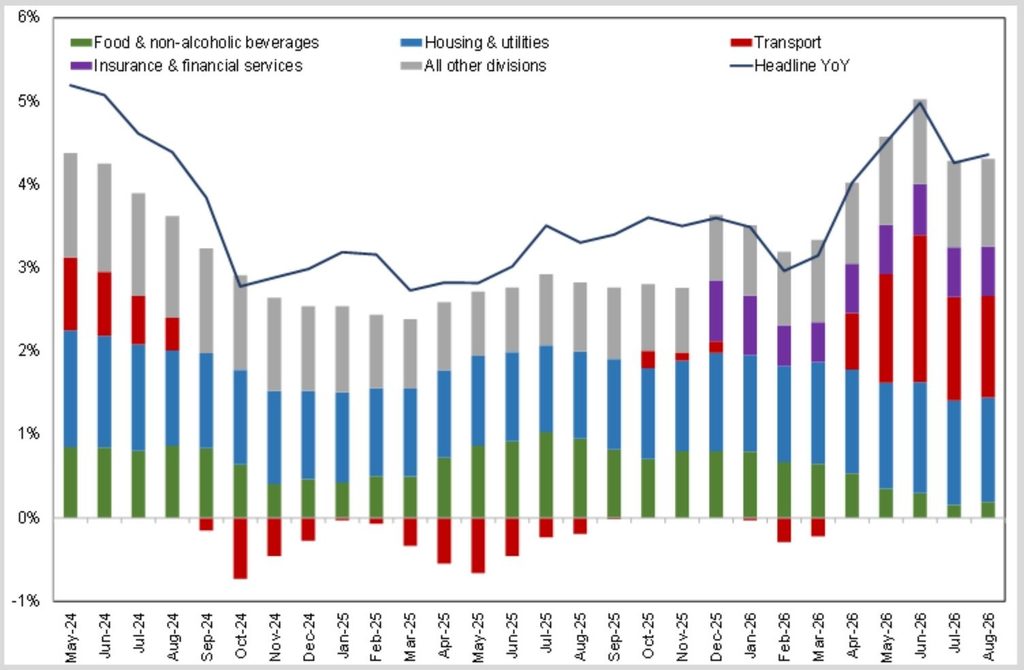
She explained that while August’s CPI print of 4.4% came in marginally softer than expected, higher oil prices and emerging risks to food prices complicate the inflation outlook.
The headline inflation figure edged up only slightly from 4.3% in July, while core inflation eased from 4.2% to 4.1%.
Ntuli explained that while headline inflation remains relatively contained, it is still above the upper end of the SARB’s 2% to 4% tolerance band and materially above its 3% target.
“The composition of inflation remains important: subdued goods and food inflation continue to provide some offset, while services, housing and transport costs remain comparatively elevated,” she said.
However, she warned that there are early signs that food disinflation is fading, as food and non-alcoholic beverage prices rose 0.1% month-on-month in August.
This was mainly driven by rising meat prices, as South African cattle farmers continue to contend with an ongoing foot-and-mouth disease outbreak.
Reserve Bank Governor Lesetja Kganyago acknowledged food inflation in his September MPC statement.
“Food inflation is at its lowest since 2010. This reflects strong harvests, as well as a levelling off in meat prices following the outbreak of foot-and-mouth disease,” he said.
“We may start to see drought pressures from El Niño soon, but for now, agricultural conditions are broadly favourable.”
Ntuli explained that while domestic food inflation remains low for now, it is expected to rise gradually from current levels.
“Higher fuel and fertiliser costs should filter into input prices, and El Niño-related weather conditions remain a risk to food production,” she said.
South Africa’s interest rate outlook
It was in this context that the MPC unanimously voted to hike South Africa’s interest rates by 25 basis points at its September meeting, bringing the repo rate to 7.25%.
“We believe the decision signals that the MPC is prioritising the credibility of its new 3% inflation target, even as the domestic growth outlook remains weak,” Ntuli said.
“The increase takes the monetary policy stance to a modestly restrictive setting.”
Looking ahead, Ntuli said the MPC is expected to keep rates unchanged at its November meeting.
She explained that the growth backdrop is weak, and a combination of record fuel prices, sticky core inflation, rising food inflation risks, rand vulnerability and a more hawkish Fed is likely to delay the resumption of monetary easing.
However, she noted that there are risks to this outlook, and another rate hike could materialise if certain factors align.
Notably, she warned that a further rate hike would become more likely if October’s CPI print exceeds 5%, core inflation accelerates, or the rand weakens sharply on a further US Federal Reserve hike.
“Conversely, a durable US–Iran settlement that reduces oil prices would bring the first cut forward,” she added.
Ntuli said the Bureau for Economic Research’s Inflation Expectations Survey for the fourth quarter of 2026 will be a major deciding factor.
This is because the third-quarter survey, while showing easing expectations, was conducted before the September fuel price increase.
With another fuel price increase expected in October, inflation expectations could rise, which will concern the Reserve Bank.
In addition, Ntuli pointed out that while the third-quarter survey showed five-year expectations easing to 4.0% from 4.1%, this remains above the Reserve Bank’s 3% target.
“So, the fourth-quarter survey, due before the November meeting, will be an important test,” she said.
Ntuli said the current interest rate path implies easing as inflation converges to the target.
She said that if the policy rate averages 6.34% in the fourth quarter of 2027 and 5.98% in the fourth quarter of 2028, it implies roughly 90 basis points of rate cuts from current levels by end-2027 and around 125 basis points by end-2028.
 Loading ...





Comments