R111.6 billion threat can sink Eskom


Eskom has warned that the R111.6 billion owed to it by municipalities threatens the company’s financial sustainability and its status as a going concern.
This warning was contained in Eskom’s annual report for the 2026 financial year, which revealed a bumper profit of R30.35 billion.
The surge in profit is largely due to fewer power outages during the past year and a sharp rise in electricity tariffs. This shows Eskom’s turnaround is gaining traction.
However, the annual report pointed to an underlying threat to Eskom’s sustainability: municipal debt, which continues to rise rapidly.
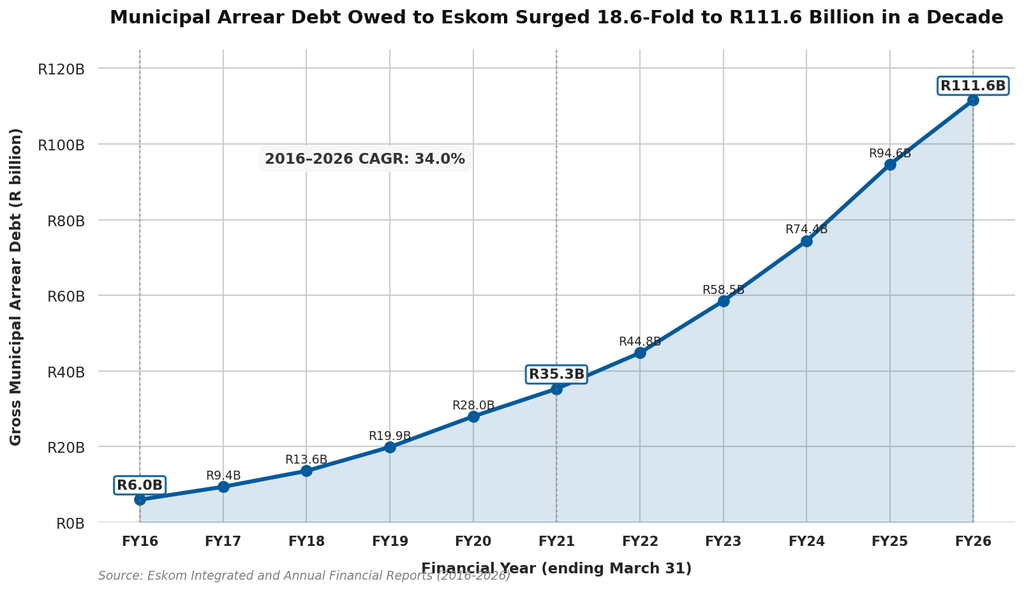
In the 2026 financial year, Eskom said municipal debt owed to it rose by R17 billion to R111.6 billion, with no signs of slowing.
This 17.9% increase in municipal debt supports CFO Calib Cassim’s 2025 warning that municipal debt could effectively nullify the government’s R254 billion bailout of the utility.
According to Eskom’s forecast, municipal debt is projected to exceed R200 billion by the end of the decade unless drastic action is taken.
Eskom said that the current level of municipal debt is a material risk to its status as a going concern and threatens its longer-term liquidity.
Resolving the municipal debt crisis is also vital for Eskom’s unbundling process, as it could sink the utility’s distribution business when it is a standalone entity.
However, Eskom has notoriously poor credit controls, as it cannot halt supply to large parts of the country without crushing the local economy.
This prevents it from using traditional credit controls to compel customers to pay, limiting its options for tackling the growing debt problem.
The utility has worked closely with the government to create the Municipal Debt Relief Programme.
This programme aimed to encourage the payment of current accounts to prevent the debt pile from growing, with the central government potentially writing off the debt of compliant municipalities.
Eskom said in its latest report that the programme has had limited success, with only 15 municipalities being compliant and having their debt written off. This amounted to R3.6 billion.
The utility expects another R4 billion to be written off in the 2027 financial year, which will not make a dent in the overall amount owed to it.
Eskom issued breach notices to non-compliant municipalities during the year, and National Treasury issued warning/termination letters to 13 municipalities in February 2026.
No municipalities have been officially removed from the relief program yet. Doing so would make them immediately liable for their outstanding arrears, plus subsequent interest and penalties.
Major progress has been made with key metros, however. In particular, the City of Johannesburg and Ekurhuleni have entered into agreements with Eskom to settle their debt.
These arrangements, along with one for the City of Tshwane, consist of interest-free loans that were classified as purchased or originated credit-impaired financial assets.
Eskom is intensifying its municipal debt management strategy through several pathways –
- Distribution Agency Agreements: Eskom is promoting active partnering solutions where it supports municipalities by managing distribution, reticulation, and revenue collections.
- Credit Control & Supply Restrictions: Eskom is pursuing PAJA (Promotion of Administrative Justice Act) processes to limit, interrupt, or terminate supply to defaulting municipalities where no other options exist.
- Legal & Governmental Escalation: Eskom is issuing summonses and participating in inter-ministerial task team subcommittees to explore legal interventions.
The graph below shows the municipal debt owed to Eskom by municipalities over the past decade.






Comments