MTN beats Vodacom, Telkom, and Cell C


MTN’s stock is the best-performing telecommunications stock on the JSE in 2026 to date, beating out Vodacom, Telkom, and Cell C.
The Y’ello company has seen its share price increase by 12.41% since the start of 2026, which has grown its market capitalisation by R39.61 billion to R350.42 billion.
According to Mordor Intelligence, South Africa’s telecoms market is valued at R176.18 billion, and is projected to grow to R209.32 billion in 2031.
The local telecoms market is mature and highly concentrated, dominated by four JSE-listed mobile network operators (MNOs): MTN, Vodacom, Telkom, and Cell C.
Private operator Rain has also become a bigger market player in recent years, giving the incumbents a run for their money.
However, the two biggest players in the market, MTN and Vodacom, still control a combined 70% of the South African telecoms MNO market.
This is due to the two companies’ long history in South Africa, with both founded in 1993 when the local telecoms market was in its infancy.
MTN and Vodacom were licensed during South Africa’s democratic transition in late 1993, and both officially launched commercial mobile networks in 1994.
The rivalry between these two companies fundamentally shaped Africa’s telecommunications market, establishing the blueprint for mobile connectivity, infrastructure investment, and digital finance.
When both operators launched in 1994, South Africa’s traditional landline infrastructure was sparse and unreliable.
The competition between Vodacom and MTN pushed them to build nationwide towers at an unprecedented pace.
This aggressive rollout allowed sub-Saharan Africa to bypass legacy copper landlines entirely and move straight to wireless connectivity.
Since their founding, MTN and Vodacom have been battling for market share in South Africa, but the largest share has gone to the Big Red MNO.
However, while Vodacom kept its focus close to home for decades, MTN focused more on global expansion and is now the largest MNO in Africa.
Telkom and Cell C

In 2026, South Africa’s telecoms market remains dominated by MTN and Vodacom, with Telkom and Cell C fighting it out for third place.
Telkom had many opportunities to become a bigger player and challenge MTN and Vodacom’s dominance, but the state-backed MNO failed to capitalise.
Telkom was also founded in 1993, and was initially a co-founder that held a 50% controlling stake in Vodacom alongside Vodafone (35%) and VenFin (15%).
This ownership structure meant that, while MTN was allowed to aggressively expand across Africa, Vodacom was restricted from operating north of the equator.
This was to avoid competing with Vodafone’s assets in Europe and other parts of Africa.
Frustrated with this restriction while its competitor expanded rapidly, Vodafone bought a 15% stake in Vodacom from Telkom in 2008. The sale gave Vodafone a 65% controlling stake in Vodacom.
A year later, Telkom unbundled its remaining 35% stake in Vodacom when it listed on the JSE, joining MTN, which had listed in 2002.
While Telkom walked away with billions in cash following these deals, it relinquished its claim to the fastest-growing mobile market in Africa.
This is where Telkom’s problems started. In the 1990s, neither MTN nor Vodacom could operate without Telkom.
At the time, Telkom owned the channels and networks that carried mobile calls between cell towers nationwide.
However, in the early 2000s, South Africa began to move away from copper landlines, and Telkom remained profitable only because of large dividend payouts from its stake in Vodacom.
This changed after Telkom relinquished its stake in Vodacom, leaving the MNO with no horse in the race and declining landline voice revenues.
The company attempted to introduce its own competitor, 8ta, in 2010, but it was too late. By that time, MTN and Vodacom had a 16-year headstart, and a new entrant could not compete.
While Telkom did not manage to take on the two big players, it has since positioned itself as a high-volume, low-cost data network.
Through its competitive data pricing and fibre infrastructure, which is held by its subsidiary, Openserve, Telkom has surpassed Cell C as South Africa’s third-largest mobile operator.
Cell C entered the market in 2001, aiming to break the Vodacom-MTN duopoly by offering extremely low prices.
However, lacking its own physical infrastructure and the capital to build it, Cell C ultimately failed to become a big market player.
Cell C ended up turning off its own physical radio access network and migrating prepaid users onto MTN’s virtualised radio network and contract users onto Vodacom’s network.
The company has since pivoted to focus more on its mobile virtual network operator (MVNO) platform model. It is the largest player in that market with between 80% and 85% market share.
MTN and Vodacom’s dominance and Telkom and Cell C’s fight for third place are also reflected in their share price performance in 2026 to date.
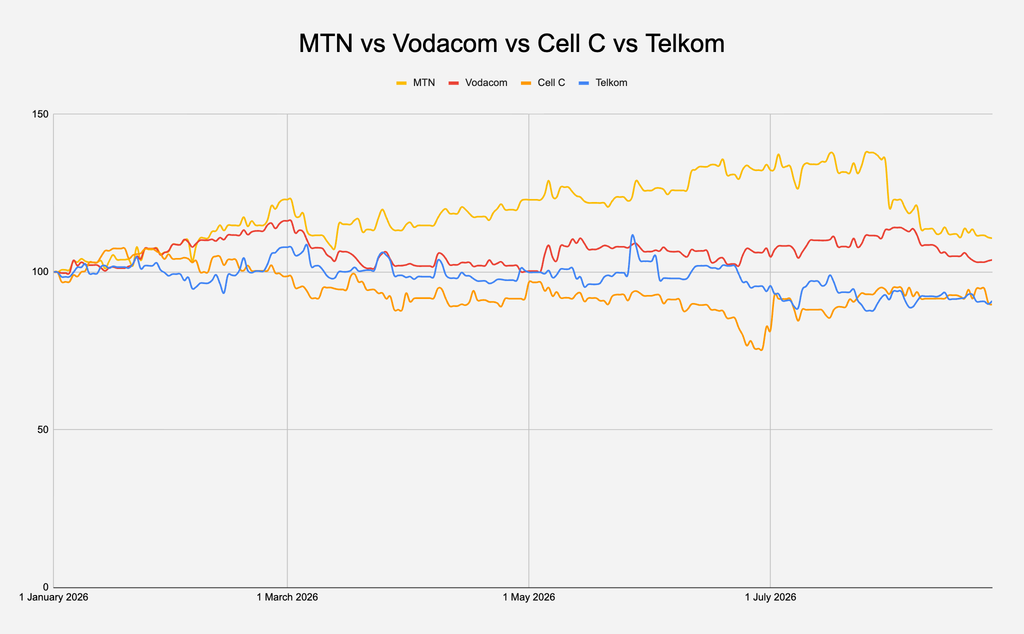
| Company | Share price return YTD |
| MTN | 12.30% |
| Vodacom | 5.07% |
| Telkom | -8.06% |
| Cell C | -10.50% |





Comments