Johannesburg spends R21 billion on salaries while trash piles up in the streets and infrastructure crumbles


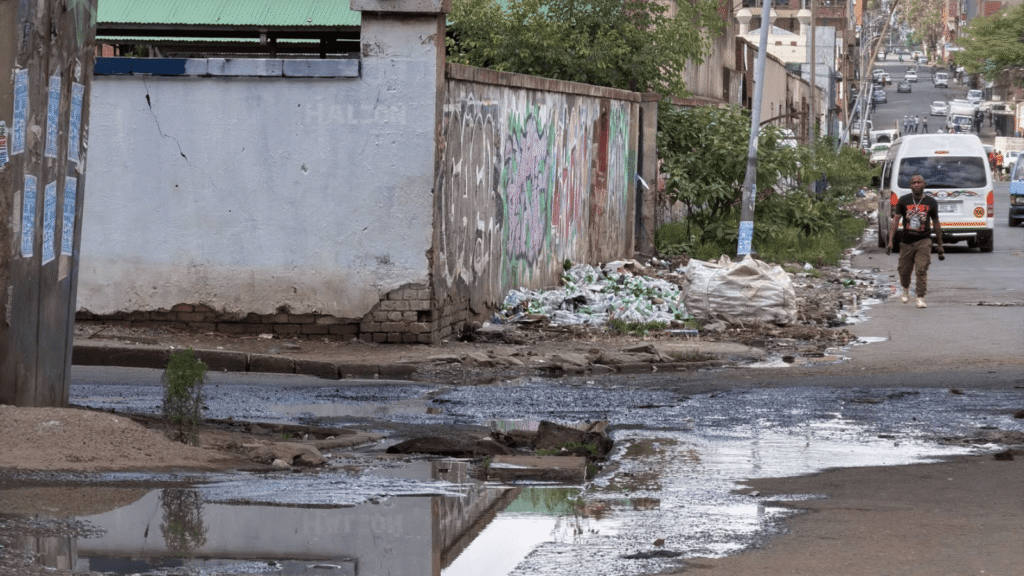
Johannesburg is spending more than R20 billion a year on employee costs while its roads, water infrastructure, substations and other municipal services continue to deteriorate.
This is according to the Centre for Development and Enterprise (CDE), which warned that Johannesburg is facing a deeper financial crisis than a simple budget shortfall.
The CDE’s latest report, Joburg’s Broken Budget, said the city is increasingly disconnected from financial reality because it budgets around revenue it has billed but not yet collected.
Over the past three financial years, Johannesburg booked R218 billion in revenue but received only R205 billion in cash.
This R13 billion gap is significant because the city cannot use unpaid bills to maintain infrastructure or settle its obligations. “It cannot pay Eskom with invoices it has issued to households,” the CDE said.
The organisation described this as a “fiscal fiction” in which the city continues to budget and spend as though all billed revenue will eventually be collected.
One of the biggest concerns raised by the CDE is the growing amount of money being spent on municipal employees.
Johannesburg has 34,453 employees, with an average remuneration of more than R600,000 per employee. This is about 20% higher than the average for national and provincial government employees.
Employee-related costs increased from about R8.6 billion in 2014/15 to R20.7 billion in 2024/25. This represents annual growth of more than 9% over the period.
The CDE said the problem is not simply that municipal employees are earning more.
Rather, the concern is that salaries are taking up an increasingly large share of the money the city actually collects from customers.
In 2014/2015, employee costs accounted for about 33% of cash paid to the city. They now account for 40%.
At the same time, average remuneration has increased by 10% a year since 2020. The CDE described this as “an astonishingly rapid rise”, given the city’s financial constraints.
The pressure could increase further because an agreement with the South African Municipal Workers’ Union is estimated to cost Johannesburg R10 billion over three years.
The CDE explained that this would be a major burden for a city that already struggles to pay suppliers, collect revenue, and maintain infrastructure.
“If the agreement is unaffordable, it should never have been made,” the report said. “If it is legally unavoidable, then the city must explain what will be cut, deferred, or abandoned to pay for it.”
Infrastructure spending has collapsed
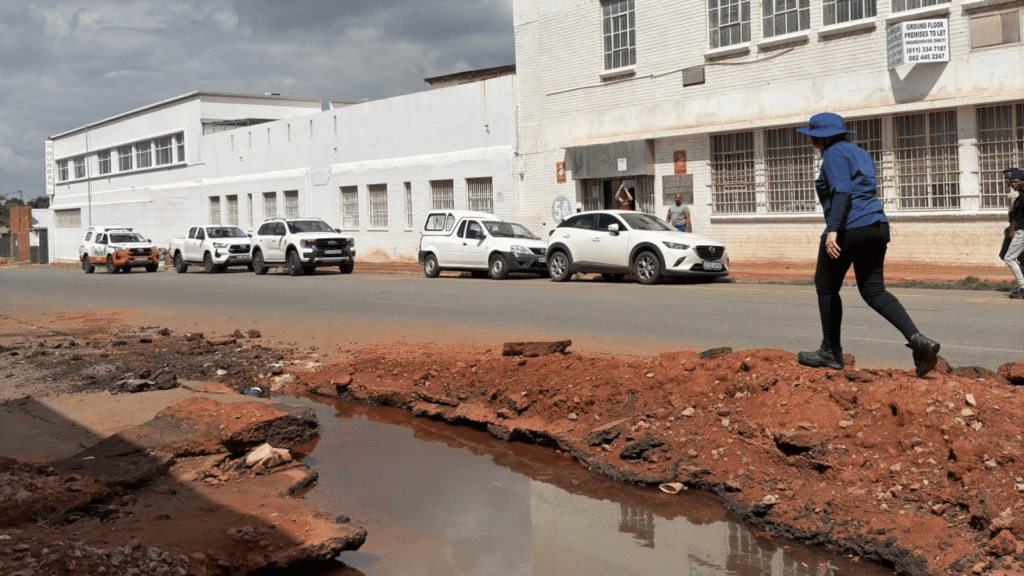
The growing salary bill is particularly concerning because it has coincided with a sharp decline in Johannesburg’s infrastructure investment.
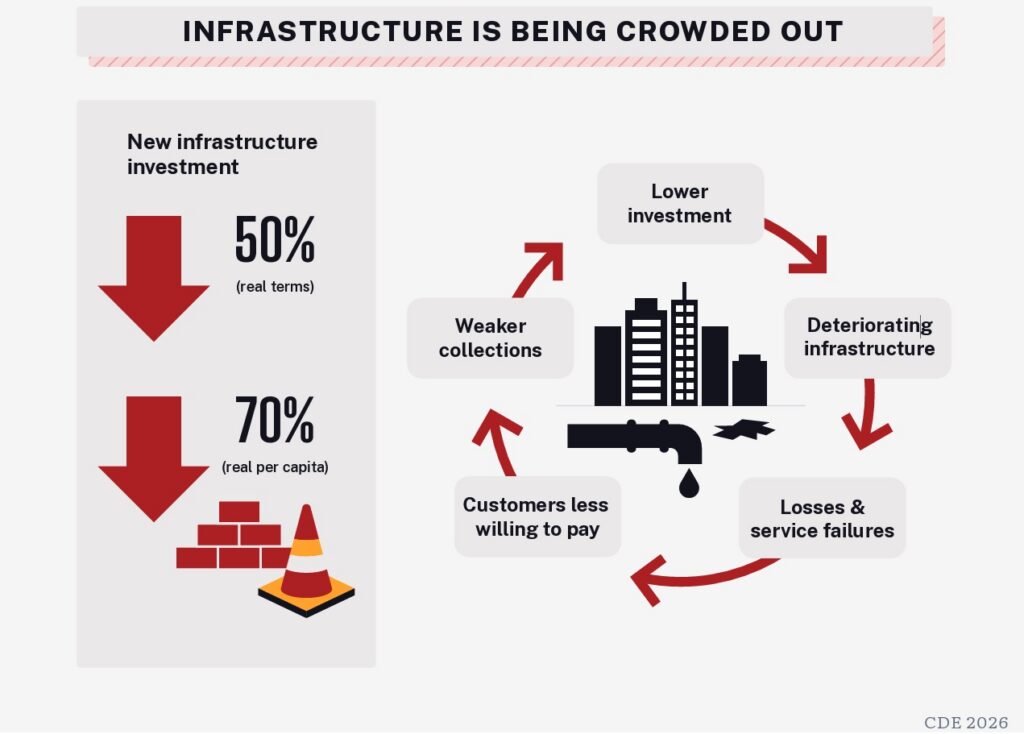
The city’s investment spending has fallen from R10 billion in 2014/15 to between R6 billion and R8.5 billion in subsequent years. However, the decline is far more severe when adjusted for inflation.
The CDE calculated that the R10 billion spent in 2014/15 would be worth nearly R16 billion in 2024/25. This means Johannesburg’s real infrastructure investment has halved over the past decade.
The decline is even greater when measured per person. Investment spending per capita has fallen by 70%, with the city now spending less than a third of what it previously spent on infrastructure per resident.
This is a major problem for a growing city that needs more roads, electricity infrastructure, water and wastewater systems, public transport, and waste facilities. Instead, the city is allowing its existing infrastructure to deteriorate.
“The city looks after its own employees first, so salaries are paid. Beyond that, it struggles to do what it is supposed to: look after the key infrastructure that makes the city work,” the CDE said.
The consequences are increasingly visible, from potholes and power outages to water leaks, broken traffic lights and failing substations.
The CDE argued that Johannesburg is effectively “consuming the future to fund the present” by prioritising current costs while allowing its infrastructure base to decline.
This creates another problem for the city’s finances. Poor infrastructure and unreliable services can reduce economic activity, weaken public trust, and encourage residents and businesses to withhold payments.
This means Johannesburg is caught between rising costs and falling investment, the CDE report explained.
Unless the city can reverse this trend, more of its future spending will have to go towards fixing infrastructure that could have been maintained or upgraded earlier.
More spending, but worse services
The growing wage bill is not happening in isolation. Spending on contracted services has also increased by more than 10% a year over the past 11 years.
This means Johannesburg is facing rising costs for employees and contractors. The CDE argued that residents have a right to question what they are receiving in return.
“If the city employs more people and spends more on contractors, why are roads collapsing, substations failing, billing systems mistrusted, water services deteriorating, and public spaces decaying?” the report questioned.
The CDE pointed to declining spending on maintenance and infrastructure investment as employee costs have absorbed a larger share of the city’s available cash.
This creates a damaging cycle. Poor service delivery can encourage residents and businesses to stop paying their municipal bills.
Lower collections, in turn, put further pressure on the city’s cash flow, which makes it harder to maintain infrastructure and pay suppliers. The result is an increasingly fragile municipal system.
Johannesburg’s financial position is also complicated by the difference between its accounting and cash position.
Over the past three financial years, the city recorded a cumulative projected surplus of R750 million. However, its actual cash position was far weaker.
On the final day of the 2024/25 financial year, Johannesburg secured a R2.5 billion loan from the African Finance and Development Bank.
The CDE estimated that, without this loan, the city would have recorded an aggregate cash deficit of R2.5 billion over the preceding three years.
As such, the organisation said Johannesburg needs a structural adjustment rather than another promise of a turnaround.
The city must collect more of what it bills, control employee and contractor costs, and protect spending on critical infrastructure.
It must also rebuild trust with residents through reliable electricity, working traffic lights, dependable water, accurate billing, and visible maintenance.
External financial support may be necessary, the CDE said, but any assistance should come with strict conditions around budgeting, revenue collection, infrastructure spending, and personnel costs.
The organisation also warned that Johannesburg’s financial crisis has implications that go beyond the city itself.
As South Africa’s largest local economy and commercial centre, Johannesburg’s decline threatens investment, employment and economic growth across the country.
The CDE added that the November 2026 local government elections provide an important opportunity for voters to choose leadership capable of stabilising the City.
“Johannesburg does not need another budget speech promising a turnaround,” it said. “It needs a reckoning.”




Comments