One man made R1 million a month selling bread to South African prisons without owning a bakery


The Department of Correctional Services has saved R77 million by getting prisoners to bake their own bread, as this improves self-sufficiency and cuts off criminal networks.
In particular, one individual siphoned R1 million per month from the department’s budget by supplying overpriced bread to South African prisons.
Correctional Services Minister Pieter Groenewald told State of the Nation that this person did not have a bakery and subcontracted their own supply.
Normally, this would not be financially viable for a business, as making a bakery profitable is extremely difficult and is dependent on vertical integration and economies of scale.
For example, Tiger Brands’ Albany has “superbakeries” around the country to leverage their scale to drive down the prices of basic inputs.
This ensures the price of Albany bread is competitive and ensures there is some profit margin in the production and sale of bread.
A single person does not have access to this scale and thus the ability to push input prices down to make their operation profitable.
However, being able to sell the bread at inflated prices can make an inefficient operation very profitable, as it was in this case.
Groenewald said the individual sold a loaf of bread to South African prisons for R24.50 after being awarded the tender. This is far above market prices.
For comparison, a loaf of Woolworths’ Thick Slice White Bread is R21.99. A loaf of Albany Superior White Bread is R17.99. Sasko brown bread goes for R15.99 at major retailers.
The inflated selling price resulted in the individual pocketing a serious profit from South African prisons. All without a bakery.
“This specific person does not have a bakery. He bought bread from wholesalers for R15 per loaf. He was pocketing R1 million a month for doing nothing,” Groenewald said.
“I stopped that, and we are now producing bread for R8 a loaf in our prisons. This saved us R77 million in the previous financial year and much more this year.”
Self-sufficiency is key
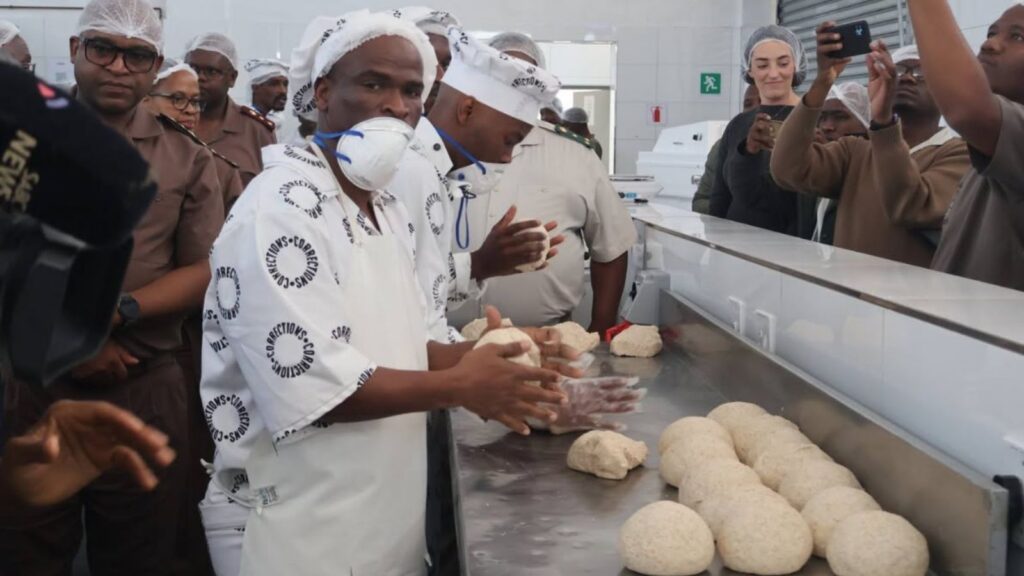
Groenewald explained that one of his aims when becoming minister was to make South Africa’s prisons more self-sufficient.
This keeps the prisoners busy and makes them productive. More importantly, it significantly cuts the cost of keeping criminals in prison.
The supply of basic foodstuffs, such as bread, ensures that the prisons can rely less on taxpayer money from the National Treasury.
At a time when South Africa is facing significant financial difficulty, cost-cutting is critical for the department to meet its constitutional obligations.
“One of my main goals is to make prisons self-sufficient. At this moment, I can say that we are 97% self-sufficient when it comes to bread,” Groenewald said.
“There are other activities, of course. In terms of our farm products, vegetables and all those sorts of things, we are becoming more self-sufficient.”
The minister said in the previous financial year, the department saved R125 million by producing its own farm products.
“When we talk about self-sufficiency, we saved R202 million for the taxpayers in the past financial year,” Groenewald said.
South African prisons are a major drain on the country’s fiscus, with the government effectively paying money to house and feed unproductive inmates.
Groenewald’s efforts are trying to make the department less of a drain on the fiscus and thus less of a consumer of taxpayer money.
The minister explained that it costs the department R482 per offender per day to house and feed them. This scaled up to R83 million a day.
This is money that could go towards funding infrastructure development, job creation, or providing healthcare and education services.
The aim to become more self-sufficient extends beyond lowering the cost of imprisonment to ensuring that rehabilitated inmates can be economically productive when they leave.
This refers to skills development and educational initiatives to ensure that inmates can be productively employed when in prison, at the bakeries, for example, and when they are free.
Groenewald has also cut spending on external consultancies from R119 million to R29 million in the past financial year and has advocated returning foreign prisoners to their home countries.



Comments