Investec’s CEO camped in the Finance Minister’s office for three years to get what he wanted


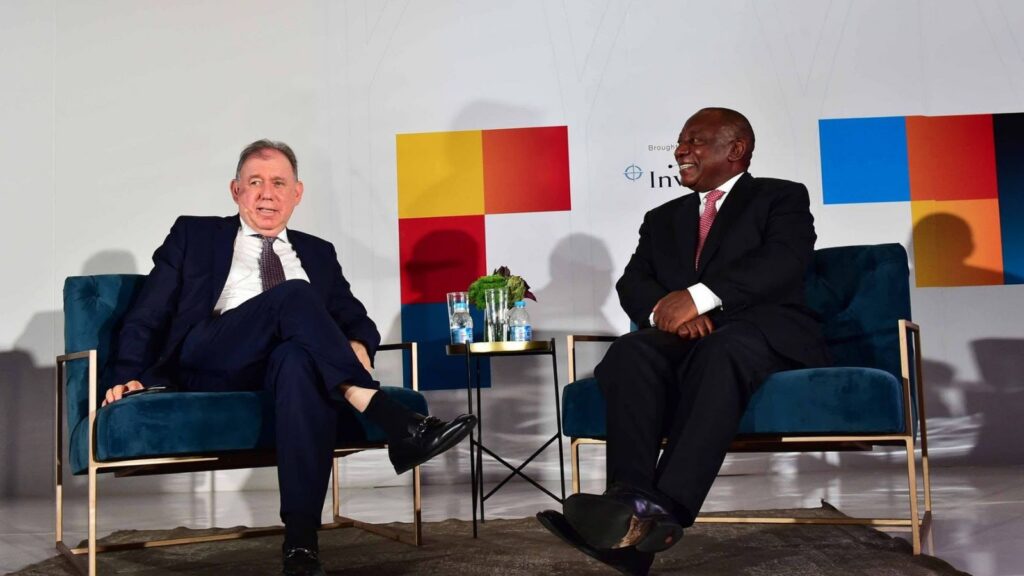
Investec CEO Stephen Koseff and chairman Hugh Herman camped in Finance Minister Trevor Manuel’s office to get permission to list the bank on the London Stock Exchange.
This three-year camp was pivotal for Investec, as it provided the bank with a foundation to expand in the United Kingdom and globally.
Koseff recalled his determination to get permission in the late 1990s in an interview with Investec Focus, where he discussed his stint as CEO.
Investec is today known as a highly exclusive global bank with operations in South Africa, the United Kingdom, the Middle East, and parts of Europe.
This is a far cry from the small leasing and financing company launched in 1974 by Larry Nestadt, Errol Grolman, and Ian Kantor.
For its first six years, Investec was not even a licensed bank. At the time, it was extremely difficult to get a banking licence in South Africa, with the Reserve Bank effectively putting a cap on the number of banks in the country.
The only way to get a licence was through a merger or acquisition. Investec finally acquired a licence in 1980, which enabled it to offer retail banking services to corporates and individuals.
Investec’s growth was turbocharged by the acquisition of a banking licence, with Koseff spearheading its merger with Metboard and listing on the JSE in 1986.
The bank steadily built out its offering by acquiring businesses in adjacent sectors, such as property management companies, merchant banks, and trade financiers.
Its acquisition strategy would see it snap up London-based Allied Trust Bank in 1992. This marked its first international purchase and its first foray into the United Kingdom.
Koseff led Investec deeper into the United Kingdom market, acquiring Guinness Mahon in 1998 and its stockbroking arm.
At the time, Investec was facing a major problem – access to financing. Koseff explained that it was costly to raise money in South Africa, given its deteriorating credit ratings.
Local companies with significant offshore operations, such as Anglo American, Old Mutual, and others, were looking for an exit.
Many turned to London as a place where they could list their company and raise capital far more cheaply for their international operations.
However, the nascent ANC government was quick to catch on, putting pressure on companies to keep their headquarters and ownership in South Africa.
Camping in Manuel’s office

Koseff saw the immense success that Anglo and Old Mutual had in raising capital in London and wanted the same for Investec.
Simultaneously, United Kingdom regulators were putting pressure on the South African bank to list in London amid its home market’s deteriorating financial health.
In the late 1990s, South Africa was experiencing financial turmoil. The government was at risk of going bankrupt, and the rand’s value versus the dollar plunged.
The ANC’s policies of Black Economic Empowerment (BEE) and transformation significantly increased companies’ compliance burden.
This pushed companies such as Anglo and Old Mutual to find ways to move their headquarters and ownership out of South Africa to reduce exposure to the ANC government and access capital.
However, when Investec went to get permission from the National Treasury, it was shut down by Manuel as he was under pressure to stem the flight of capital from South Africa.
“We were trying to get permission to list in London, and Manuel kept the door shut on us. So, eventually, we just camped in his office. Hugh Herman, our chairman, and I sat there waiting for him,” Koseff said.
“We wanted to catch Manuel and begin the process of enabling us to get a listing in London. It took us from 1998 to 2001 to get that right.”
Not only did it take three years, but Investec was pushed into using a unique dual-listing structure to avoid what had happened with Anglo and Old Mutual.
“Originally, we were looking for a listing in London that would own South Africa. Similar to what Old Mutual had done and what Anglo American had done,” Koseff said.
“By that time, Manuel said there were no more of those structures being approved. We ended up doing the dual-listed structure that Investec has today.”
“This taught me the lesson of not giving up. If you have something you need to do in life and it makes sense, keep banging on the door. Eventually, they will see the logic.”
Koseff said Manuel was being emotional about the issue at the time and just did not want to see another South African company listed in London.
This structure benefits Investec in that its United Kingdom bank has an A credit rating while South Africa is below investment grade.
“It really worked out well for us, because I don’t think we would have been able to operate in London as a South African subsidiary,” Koseff said.
 Loading ...





Comments