South African municipalities are falling into a debt trap


Municipalities across South Africa are becoming increasingly dependent on debt to finance their municipal assets, with many subsequently being unable to pay this debt back.
This was revealed in a recent publication from Stats SA, detailing various aspects of municipal finances over the past 20 years.
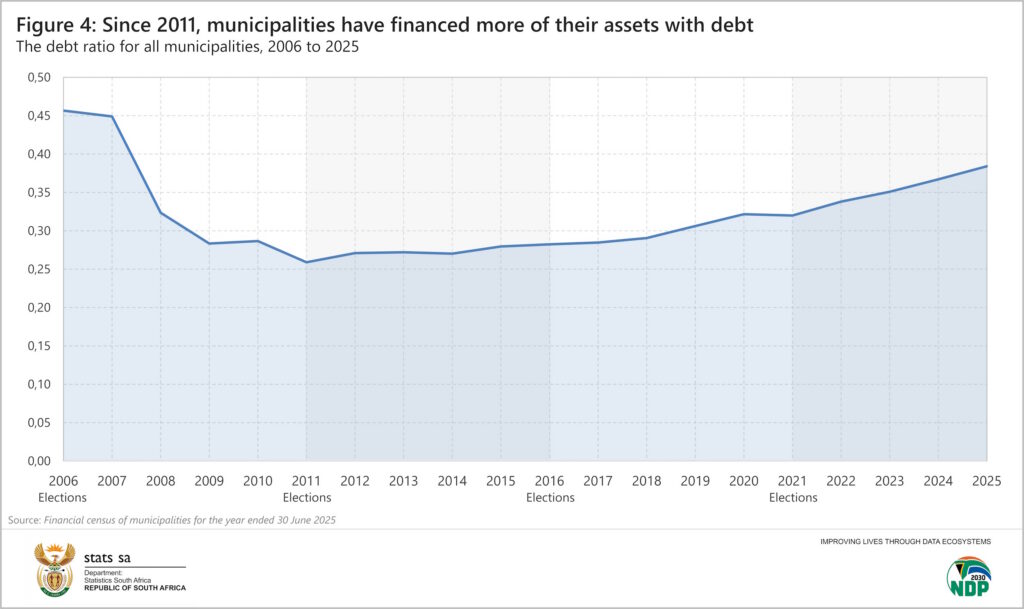
One of these is South Africa’s debt-to-asset ratio, showcasing the proportion of total municipal debt relative to the total value of municipal assets currently held.
Since hitting a low of 0.26 in 2011, this debt ratio has slowly risen over the years to reach 0.38 in 2025, showing a growing reliance on debt to cover assets.
Total municipal liabilities across South Africa grew from R402 billion as of 30 June 2024 to over R442 billion as of 30 June 2025, a jump of around 10% in just a single year.
In the same span of time, the country’s total municipal assets only grew by around 5%, from just under R1.1 trillion in 2024 up to R1.15 trillion in 2025.
The North West and Mpumalanga had the highest surges amongst the country’s 9 provinces, with each showing a more than 18% growth in liabilities between 2024 and 2025.
Meanwhile, the Maluti-a-Phofung Local Municipality and the West Rand District Municipality stood as noticeable outliers, with debt ratios of 2.70 and 2.32 respectively.
As per the Municipal Finance Management Act, municipalities can incur long-term debt to finance capital expenditure on fixed assets used for achieving local government objectives.
The City of Johannesburg recently approved a R3.8 billion loan from the German state-owned development bank Kreditanstalt für Wiederaufbau to service and upgrade electricity infrastructure.
Meanwhile, the City of Cape Town has taken out multiple large loans in recent years to support its investments in infrastructure.
This included a R3.5 billion loan from Nedbank in 2024, as well as R2.8 billion from the International Financial Corporation and R2 billion from the French Development Agency the year before.
Municipalities take on debt they can’t pay back
With the growing dependence on debt to finance municipal assets, concerns have been raised around the ability for many of these municipalities to pay their debts off.
Stats SA’s municipal finance report showed that operational expenditure at South Africa’s municipalities had increased on a consistent basis with revenue over the years.
Total revenue at municipalities increased by around 7% from R579 billion in 2024 up to R620 billion in 2025, leaving the latest debt-to-income ratio at 0.71.
This means South Africa’s municipal debt is currently increasing at a faster rate than municipal revenue can keep up with.
The Auditor-General of South Africa (AGSA) raised concerns around the capacity of municipalities to pay back their debts in her latest Local Government Audit Outcome report.
According to the report, total municipal liabilities had reached R417.26 billion by the end of the 2024/25 financial year.
This included R289.32 billion in short-term debts to goods and services providers such as Eskom, as well as R79.07 billion in other borrowings such as interest-bearing bonds, among other debts.
17 of South Africa’s municipalities were reported to have an adverse solvency ratio, meaning their liabilities exceeded their assets.
On top of this, the AGSA said the country’s current assets were insufficient to cover its current liabilities, with the country’s current ratio sitting at 0.86:1.
This means that as a whole, South Africa’s municipalities would not have the means to pay what they owe to their creditors even after all their debts have been collected.
More than half of the country’s municipalities possessed adverse current ratios, while 72% of them also did not have enough cash to pay their creditors.
Despite municipalities legally being required to pay creditors within 30 days of receiving an invoice or statement, the AGSA reported that 136 municipalities failed to pay on time.
As these debts went unpaid, they accrued interest fees and late payment penalties, adding further to the financial burden on South Africa’s municipalities.




Comments