Pick n Pay going from zero to hero


Two years into its turnaround plans, Pick n Pay believes its foundations are far stronger and that it can return to sustainable profitability.
Two key developments that should reflect in the retailer’s future results are the signing of a better logistics contract and the reconfiguration of Pick n Pay’s labour model.
The retailer is also set to continue reaping the rewards of its completed store estate reset, which has seen Pick n Pay close down numerous loss-making stores over the past few years.
Pick n Pay’s large stake in discount retailer Boxer, which the retailer said it does not plan to sell down further, will also boost the company’s value in investors’ eyes.
In its Integrated Annual Report for the 2026 financial year, Pick n Pay CEO Sean Summers called it an “important year” for the retailer’s recovery.
“While there is still a significant amount of work ahead of us, Pick n Pay today is fundamentally stronger than it was at the beginning of this journey,” he said.
A Pick n Pay stalwart, having served as CEO from 1999 to 2007, Summers has spearheaded the retailer’s recovery efforts since he took back the helm in 2023.
From a R4 billion rights offer, to unbundling and listing Boxer, closing over 100 stores, and selling even more of its Boxer stake, Summers has been hard at work to restore Pick n Pay to its former glory.
“We have sharpened our focus on the very fundamentals of retail execution,” Summers said in the annual report.
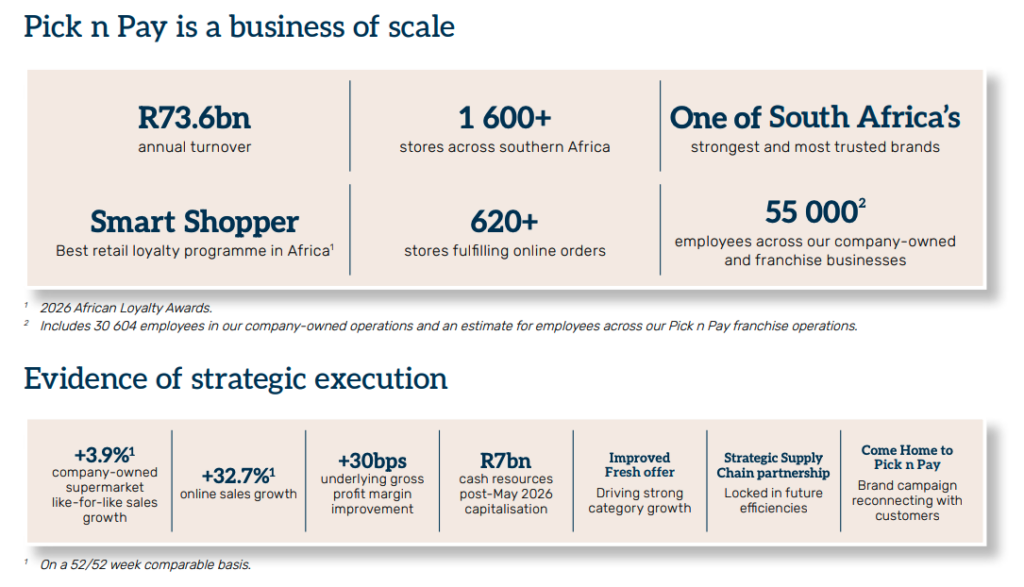
“We have improved our store standards, expanded our range, strengthened product availability, enhanced our Fresh offer and continued to focus on our price competitiveness in an exceptionally constrained consumer environment.”
“Encouragingly, our customers are responding positively to the improvements being made across the business.”
However, the nagging problem remains that these improvements are taking a long time to reflect in Pick n Pay’s bottom line.
While the group has managed to reduce its headline loss per share in the 2026 financial year, the retailer’s stand-alone Pick n Pay Stores segment remains in the red.
In addition, Summers announced earlier this year that Pick n Pay’s break-even target date for this segment would be pushed back to the 2029 financial year, a year later than initially anticipated.
More work to be done
Summers acknowledged that the gains Pick n Pay has made so far have been measured and incremental, though he said they have all gone towards rebuilding a stronger and more competitive retailer.
“We remain clear-eyed about the reality that Pick n Pay is still loss‑making. That remains the central challenge we are working to overcome, and it is why the work of rebuilding the business cannot lose momentum,” he said.
“We are absolutely resolute in returning Pick n Pay to break-even and then on to sustainable long-term profitability.”
He said that while the recovery path remains demanding, the operational foundations being rebuilt across the group are steadily positioning Pick n Pay for a stronger and more sustainable future.
While it may have struggled over the past decade, Pick n Pay remains a business of note – if only due to its sheer brand recognition among South African consumers.
In addition, while the business’s bottom line is struggling, this does not change the fact that it still generated an immense R73.6 billion in turnover for the 2026 financial year.
It also boasts a footprint of more than 1,600 stores across southern Africa, even after completing the store closure programme.
The retailer’s stake in Boxer also gives it an edge, as the discount retailer is booming, and Pick n Pay still holds a sizeable 53.1% stake.
While the next three years will be telling – particularly regarding the Pick n Pay segment’s break-even target – some investors have bought into the retailer’s turnaround.
For example, Protea Capital Management CEO JP Verster recently said that he is optimistic about Pick n Pay’s prospects for the first time in a decade.
Other investors will need more convincing, with Pick n Pay’s share price currently down around 14% in the year to date.
“For 59 years, Raymond and Wendy Ackerman built an institution grounded in values, service, courage and care for South Africa and its people,” Summers said.
“All of us who are part of Pick n Pay today carry a responsibility to protect and rebuild that legacy for the next generation.”
“Our work is far from complete, but meaningful progress is being made.”




Comments