Former Capitec CEO reveals how millions of South Africans get a free ‘second salary’ from the government


Millions of South Africans receive social grants from the state despite being employed and earning up to five times as much as the qualifying amount.
These grant payments serve as a second salary to supplement the income these individuals earn from standard employment.
Former Capitec CEO Gerrie Fourie explained how the bank’s data shows this clearly in a recent webinar hosted by the Efficient Group.
Fourie said South Africa faces a significant challenge in understanding the local informal economy and how many individuals are employed in it.
This lack of understanding prevents the country from creating policies and initiatives to support the informal economy.
Hidden from view, the informal economy is estimated by Standard Bank to be worth R900 billion annually and to provide employment to millions of people.
However, much of this is undocumented and untraced. This means it does not appear in economic statistics on GDP and employment.
Fourie has famously estimated that South Africa’s real unemployment rate is only 10%, as millions of people are self-employed in the informal economy.
This does not fall under Stats SA’s definition of employment, and so they are classed as unemployed, resulting in the rate being inflated, Fourie claimed.
“Our unemployment rate is definitely not 32%. Nobody will convince me that it is 32%. Our unemployment rate is between 10% and 15%,” Fourie said.
“If you really want to change South Africa, you cannot look to the government and big companies to solve unemployment. Entrepreneurs will solve it.”
Fourie’s claim appears to be supported by the data, with Stellenbosch University economic historian Johan Fourie saying it is incomprehensible compared to the country’s peers.
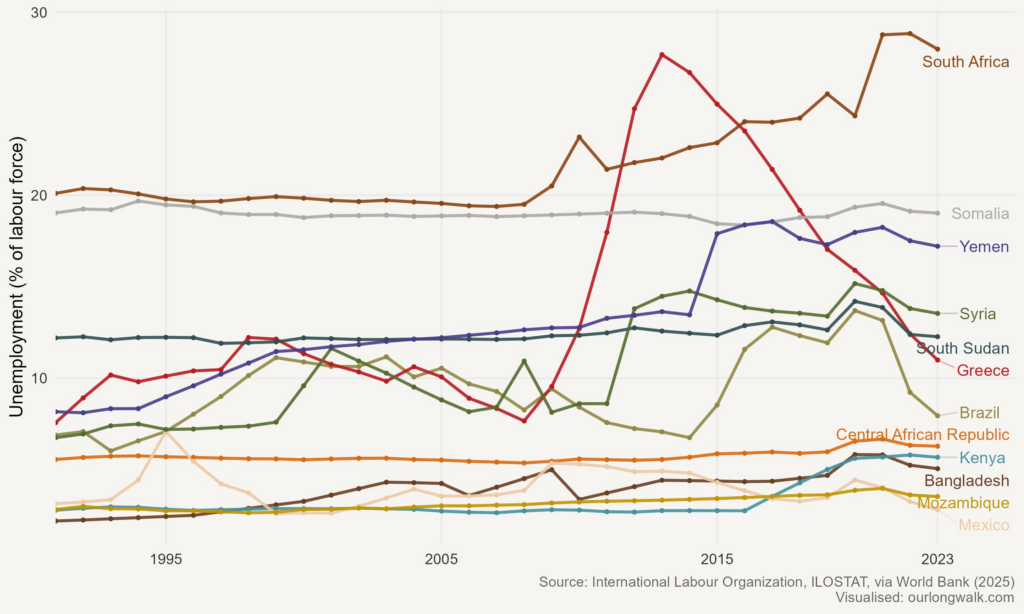
South Africa is a huge outlier when it comes to unemployment, with its rate being more than double that of the next-worst countries, Somalia and Yemen, which are active warzones.
“Brazil, Kenya, and Mexico all have rates that are barely a fraction of ours, making South Africa’s position not just unusual, but almost incomprehensible by global standards,” Johan Fourie said.
South Africa’s outlying position can be seen in the graph below, courtesy of Johan Fourie at Our Long Walk.
Don’t say you are employed
The former CEO‘s explanation for South Africa’s outlier position is based on the country’s social grants system.
This system is highly effective at putting cash into the hands of South Africans who need support, with around 28 million people receiving a grant.
However, it also encourages people to report to the authorities that they are unemployed, as doing so allows them to continue receiving social grant payments.
Fourie explained that if Stats SA’s unemployment survey were done by a different organisation, the data would look completely different, as people would give different answers.
This is particularly true for individuals who benefit from the state not knowing that they are employed. These people use social grants to supplement their income.
“I told Stats SA that we have a big problem with social grants. If you ask someone who gets a social grant if they are employed or unemployed, they will never say employed,” Fourie said.
“The moment that they say ‘I’m employed’, they lose all their social grants. There is no way they are going to answer: Employed.”
Fourie said the country’s biggest banks can see this clearly in their data, with individuals receiving income from social grants and other sources.
These individuals are not formally employed, so they do not get a salary, but they receive payments into a personal account from running a small business or picking up short-term work.
“We have gone through all our data at Capitec on all of our customers who are getting social grants, because we can see it,” Fourie said.
“Their income levels, on social grants versus other income, that other income is about five times higher.”






Comments